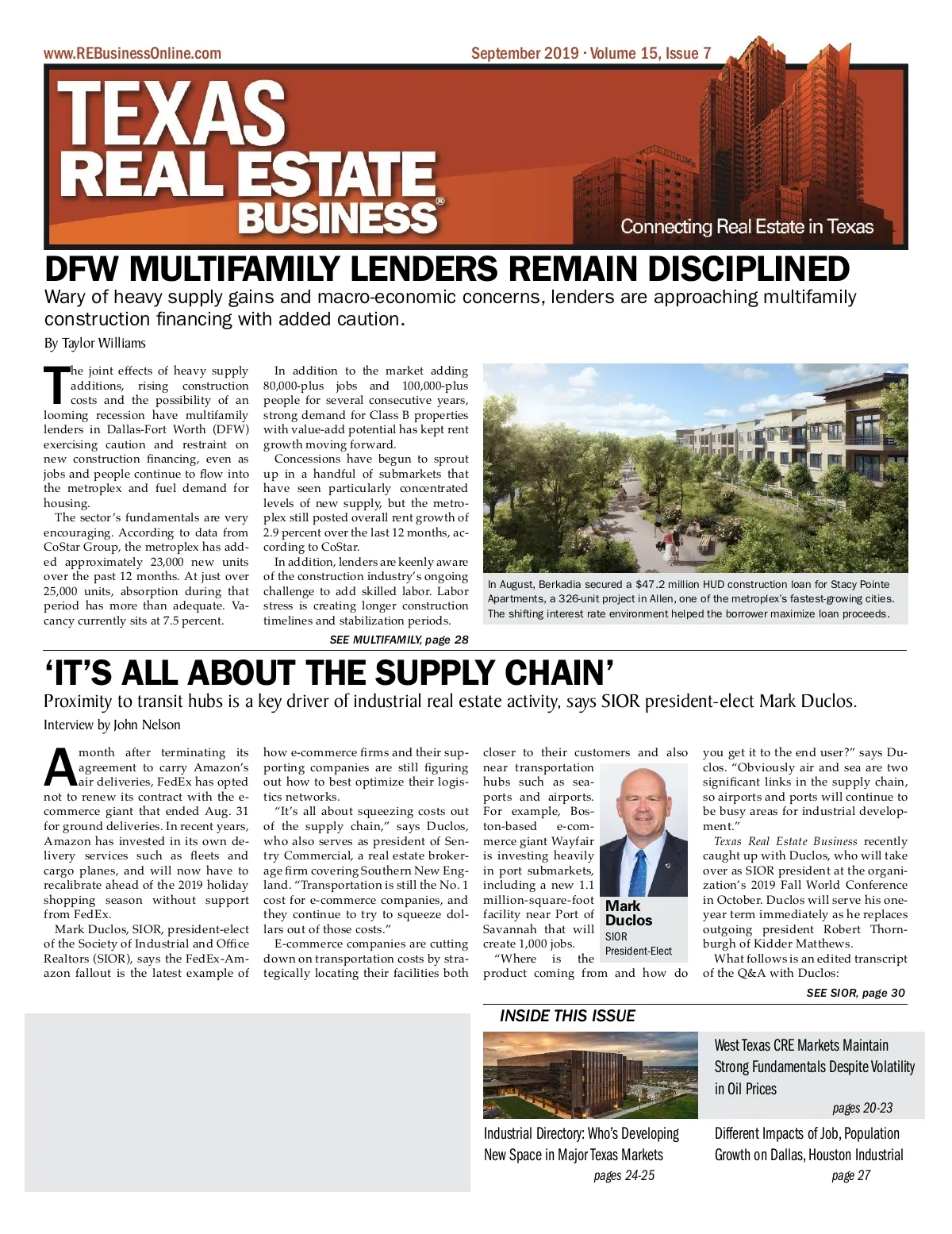
www.REBusinessOnline.com September 2019 • Volume 15, Issue 7 DFW MULTIFAMILY LENDERS REMAIN DISCIPLINED Wary of heavy supply gains and macro-economic concerns, lenders are approaching multifamily construction financing with added caution. By Taylor Williams he joint effects of heavy supply additions, rising construction costs and the possibility of an looming recession have multifamily lenders in Dallas-Fort Worth (DFW) exercising caution and restraint on new construction financing, even as jobs and people continue to flow into the metroplex and fuel demand for housing. The sector’s fundamentals are very encouraging. According to data from CoStar Group, the metroplex has add-ed approximately 23,000 new units over the past 12 months. At just over 25,000 units, absorption during that period has more than adequate. Va-cancy currently sits at 7.5 percent. T In addition to the market adding 80,000-plus jobs and 100,000-plus people for several consecutive years, strong demand for Class B properties with value-add potential has kept rent growth moving forward. Concessions have begun to sprout up in a handful of submarkets that have seen particularly concentrated levels of new supply, but the metro-plex still posted overall rent growth of 2.9 percent over the last 12 months, ac-cording to CoStar. In addition, lenders are keenly aware of the construction industry’s ongoing challenge to add skilled labor. Labor stress is creating longer construction timelines and stabilization periods. In August, Berkadia secured a $47.2 million HUD construction loan for Stacy Pointe Apartments, a 326-unit project in Allen, one of the metroplex’s fastest-growing cities. The shifting interest rate environment helped the borrower maximize loan proceeds. SEE MULTIFAMILY, page 28 ‘IT’S ALL ABOUT THE SUPPLY CHAIN’ Proximity to transit hubs is a key driver of industrial real estate activity, says SIOR president-elect Mark Duclos. Interview by John Nelson month after terminating its agreement to carry Amazon’s air deliveries, FedEx has opted not to renew its contract with the e-commerce giant that ended Aug. 31 for ground deliveries. In recent years, Amazon has invested in its own de-livery services such as fleets and cargo planes, and will now have to recalibrate ahead of the 2019 holiday shopping season without support from FedEx. Mark Duclos, SIOR, president-elect of the Society of Industrial and Office Realtors (SIOR), says the FedEx-Am-azon fallout is the latest example of A how e-commerce firms and their sup-porting companies are still figuring out how to best optimize their logis-tics networks. “It’s all about squeezing costs out of the supply chain,” says Duclos, who also serves as president of Sen-try Commercial, a real estate broker-age firm covering Southern New Eng-land. “Transportation is still the No. 1 cost for e-commerce companies, and they continue to try to squeeze dol-lars out of those costs.” E-commerce companies are cutting down on transportation costs by stra-tegically locating their facilities both closer to their customers and also near transportation hubs such as sea-ports and airports. For example, Bos-ton-based e-com-merce giant Wayfair is investing heavily in port submarkets, including a new 1.1 million-square-foot Mark facility near Port of Duclos Savannah that will SIOR create 1,000 jobs. President-Elect “Where is the product coming from and how do you get it to the end user?” says Du-clos. “Obviously air and sea are two significant links in the supply chain, so airports and ports will continue to be busy areas for industrial develop-ment.” Texas Real Estate Business recently caught up with Duclos, who will take over as SIOR president at the organi-zation’s 2019 Fall World Conference in October. Duclos will serve his one-year term immediately as he replaces outgoing president Robert Thorn-burgh of Kidder Matthews. What follows is an edited transcript of the Q&A with Duclos: SEE SIOR, page 30 INSIDE THIS ISSUE West Texas CRE Markets Maintain Strong Fundamentals Despite Volatility in Oil Prices pages 20-23 Industrial Directory: Who’s Developing New Space in Major Texas Markets pages 24-25 Different Impacts of Job, Population Growth on Dallas, Houston Industrial page 27
Texas Real Estate Business September 2019: Page 1