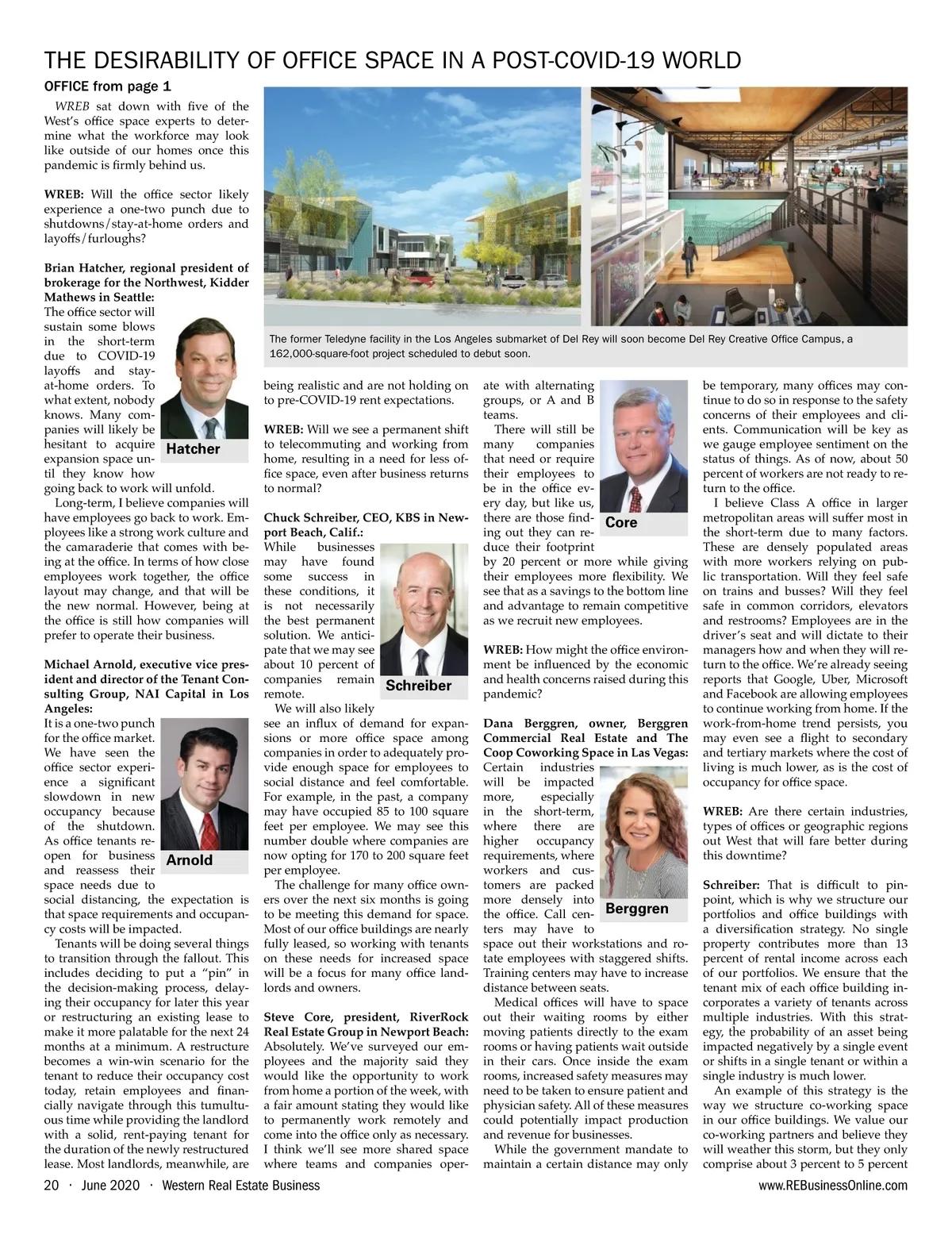
of our overall portfolio. This provides downside protection against unfore-seen factors that could negatively im-pact an industry or tenant. Hatcher: The Western region will outperform most of the other areas of the country, mainly because tech and life sciences are strong through-out the West and will continue to grow. It is clear that health, combined with technology, will be the sectors to grow. Ecommerce has also accelerated during this crisis, which will lead to much higher demand in industrial warehouse space, especially close-in and last-mile locations. Further, it is clear that certain medical items, such as PPE, have not been in as high sup-ply as needed. The government and local companies who provide and distribute PPE will see their need for space grow. It is predicted employ-ment, especially in West Coast cities, will be secure, thus fi lling the possible short-term vacancies in multi-family; one sector that will remain strong. WREB: Creative offi ce was a fairly popular trend before COVID-19. How might the impact of this virus aff ect this offi ce style? Core: We’re struggling with that trend ourselves. How do you run an open offi ce environment and provide for social distancing and other healthy practices? We believe that we’ll see less demand for space as a lot of us have learned how to work remotely. I think it’ll take a while for everyone to evaluate their true needs. This will drive a slowdown on lease commit-ments and vacancy may spike in the near future. Learning how to run more effi ciently is the bright spot in all of this for companies, but may not be great for the property owners. Arnold: For years, the creative of-fi ce concept called for placing more employees into smaller spaces, while creating an open, collaborative atmo-sphere. When one thinks about a high-ly dense working environment, side-by-side bench workstations and the clustering of iconic high-tech startups and industries, the Westside’s Silicon Beach offi ce market comes to mind. The Westside is the largest offi ce market in Los Angeles County with the greatest amount of creative offi ce space. However, almost all industries were demanding creative offi ce space and developers, to remain competi-tive, took their cue from tenants to build it — not just on the Westside. One of the largest projects under con-struction or renovation was Broad-way Trade Center in Downtown Los Angeles. The 1.1-million-square-foot historic structure, owned by Water-bridge Capital, was built in 1912 and was scheduled for delivery in the fi rst quarter of 2020. Broadway Trade Cen-ter includes more than 585,000 square Some companies may opt to have employees return to the of ce only for crucial meetings, though social distancing and elevated sanitation levels will likely remain even after COVID-19. feet of creative offi ce space, which re-mains vacant. Continental Develop-ment and Mar Ventures recently broke ground on a new offi ce campus at the site of a former Teledyne facility in Del Rey that housed 1960s-era indus-trial buildings. Del Rey Creative Of-fi ce Campus is a 162,000-square-foot project scheduled to debut in 2020. It also remains vacant. Berggren: Creative offi ce design al-lows for more social interaction. If company culture is important, you still have to create opportunities for connection, collaboration and innova-tion. Creative offi ces will remain, but companies will have to take steps to ensure their workers return to a space where they feel safe, healthy and pro-ductive. Architects and designers are rei-magining offi ce design based on this new paradigm shift in workplace safety and distancing protocols. These include plexiglass dividers, swap-ping out benching at long tables to higher-walled cubicles and stagger-ing work shifts so there is less density in the workspace. Another trend in cities with a more temperate climate will be a shift to use outdoor areas. Instead of being confi ned to the in-door space with questionable air qual-ity and greater opportunity for germ transmission, expect an increase in the utilization of outdoor space with fresh air and natural light. If anything, cre-ative space will need to be more cre-ative. WREB: How might new leases, tenant allowances and lease renewals be im-pacted going forward? Core: Asking rates in some markets have already been impacted. As em-ployers are still trying to assess the long-term impacts of COVID-19, I think there will be a slowdown on lease executions. When you apply this trend to the potential shift to working remote, it is probable that deal fl ow will be impacted. For those ready to commit, they’ll want to take advan-tage of longer-term leases, while land-lords will push for shorter terms in the hope that rates recover to pre-COVID levels. Arnold: This is the million-dollar question. I can tell you that I am working on four diff erent leases for companies that were all ready to ex-ecute prior to COVID-19. In each in-stance, I have been able to eff ectuate lease negotiation restructures and reductions between 9 percent and 25 percent post-COVID-19. The leases in-cluded higher tenant improvement al-lowances, additional rental abatement and reduction in starting rent and rental increases. Previously, landlords were looking to securitize 100 percent of out-of-pocket expenses. Now they seem, in certain cases, more “moti-vated” to make a deal with a credit or good tenant they believe in. These deals have been anywhere from fi ve to 11 years! The issue is that most landlords think about what the rents were rather than where they will be going. We all knew there was a correction coming — we just didn’t know the impetus behind it. If an advisor or consultant is not doing a debt analysis of what the landlord has maturing, as well as understand the nuances of both the building and market, then they are doing their client a disservice. Anyone can fi nd a vacant or available space, but not everyone has the tools to truly analyze and implement a strategic plan to assist their client in negotiat-ing the most favorable terms and con-ditions that align their business with their real estate and not the inverse! n Architectural dog park products WATER FOUNTAINS FUN AGILITY PLAY EQUIPMENT WASTE STATIONS GymsForDogs.com sales@GymsForDogs.com 800-931-1562 www.REBusinessOnline.com Western Real Estate Business • June 2020 • 21
Western Real Estate Business June 2020: Page 21