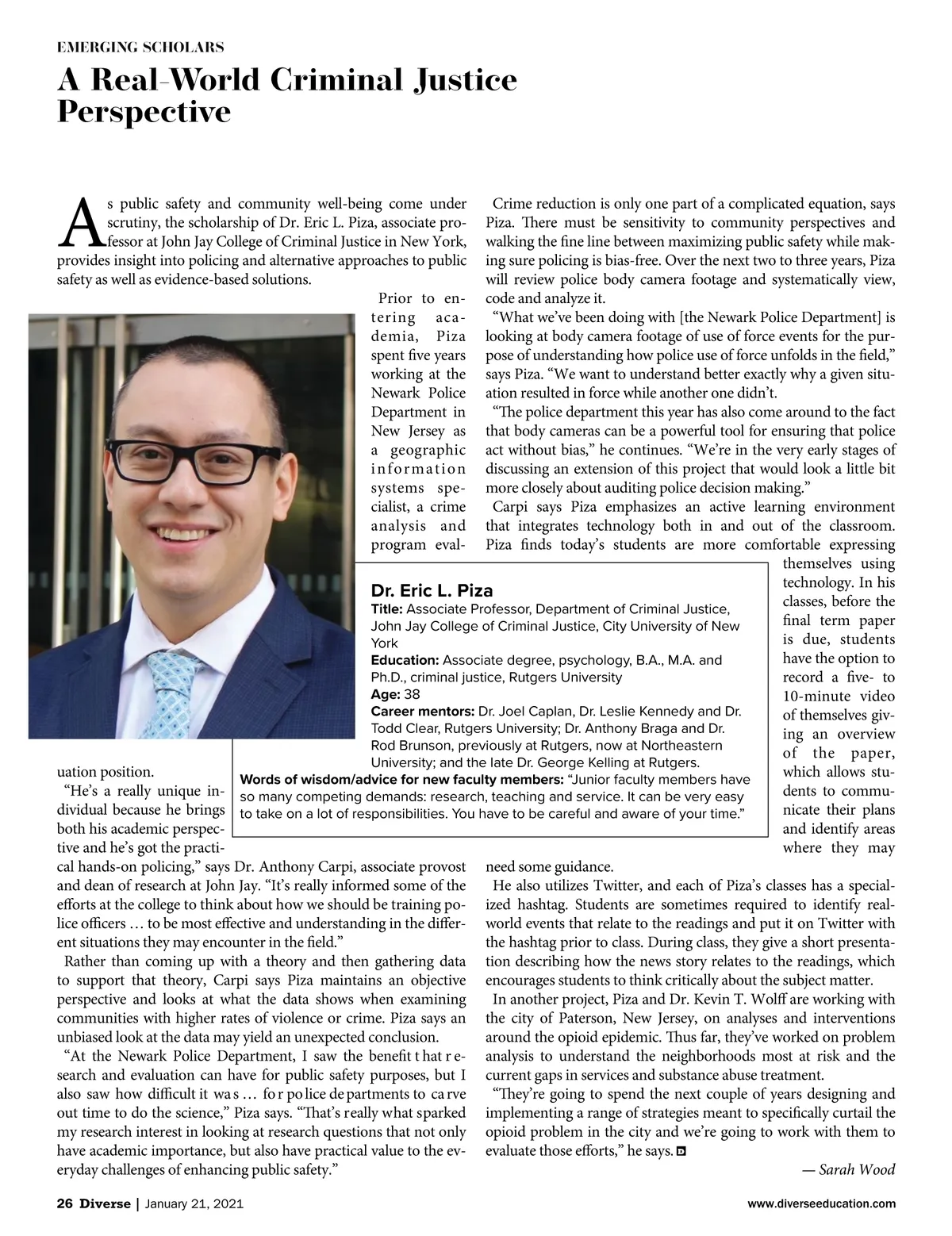
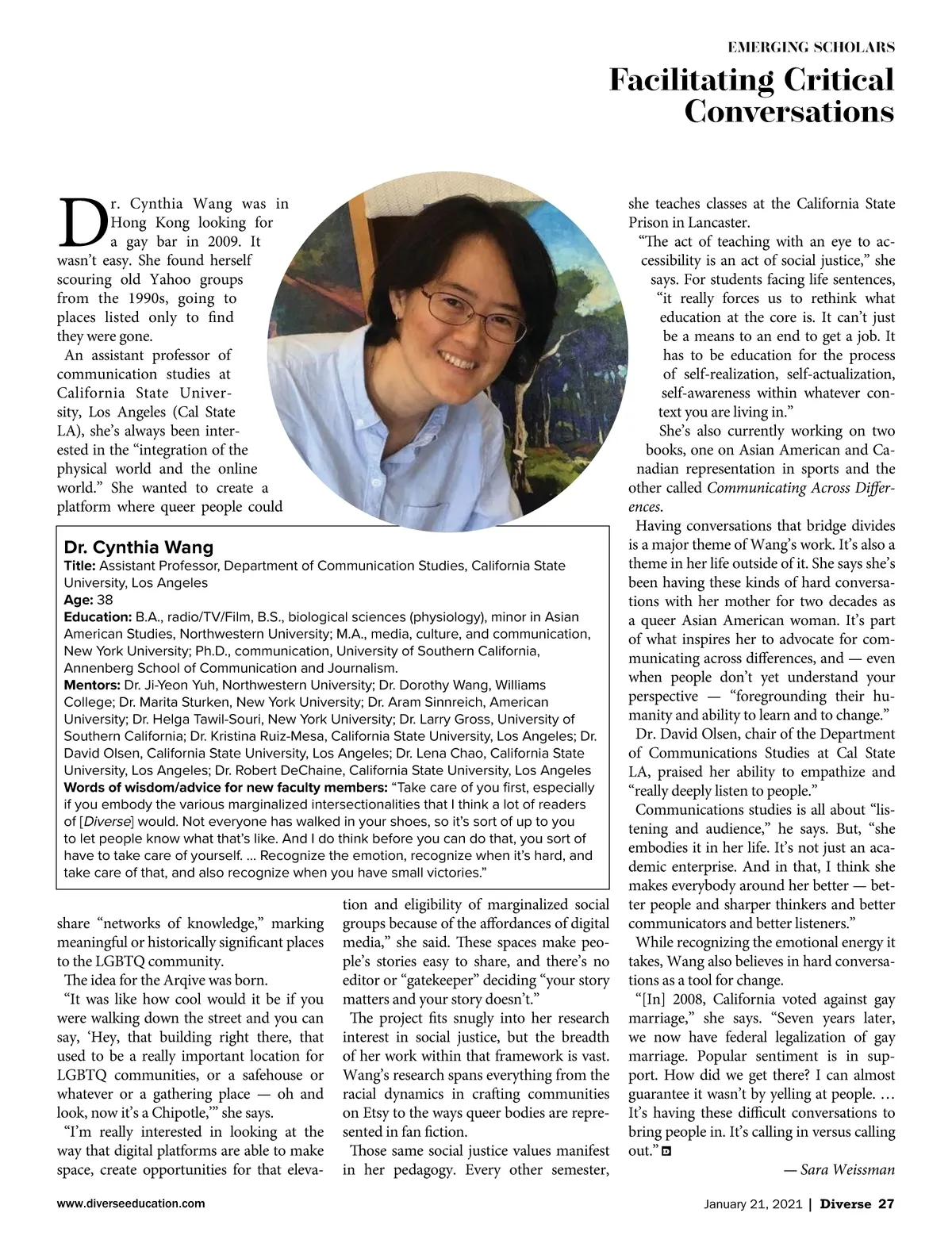
Facilitating Critical Conversations r. Cynthia Wang was in Hong Kong looking for a gay bar in 2009. It wasn’t easy. She found herself scouring old Yahoo groups from the 1990s, going to places listed only to fi nd they were gone. An assistant professor of communication studies at California State Univer-sity, Los Angeles (Cal State LA), she’s always been inter-ested in the “integration of the physical world and the online world.” She wanted to create a platform where queer people could EMERGING SCHOLARS D Dr. Cynthia Wang Title: Assistant Professor, Department of Communication Studies, California State University, Los Angeles Age: 38 Education: B.A., radio/TV/Film, B.S., biological sciences (physiology), minor in Asian American Studies, Northwestern University; M.A., media, culture, and communication, New York University; Ph.D., communication, University of Southern California, Annenberg School of Communication and Journalism. Mentors: Dr. Ji-Yeon Yuh, Northwestern University; Dr. Dorothy Wang, Williams College; Dr. Marita Sturken, New York University; Dr. Aram Sinnreich, American University; Dr. Helga Tawil-Souri, New York University; Dr. Larry Gross, University of Southern California; Dr. Kristina Ruiz-Mesa, California State University, Los Angeles; Dr. David Olsen, California State University, Los Angeles; Dr. Lena Chao, California State University, Los Angeles; Dr. Robert DeChaine, California State University, Los Angeles Words of wisdom/advice for new faculty members: “Take care of you fi rst, especially if you embody the various marginalized intersectionalities that I think a lot of readers of [Diverse] would. Not everyone has walked in your shoes, so it’s sort of up to you to let people know what that’s like. And I do think before you can do that, you sort of have to take care of yourself. … Recognize the emotion, recognize when it’s hard, and take care of that, and also recognize when you have small victories.” share “networks of knowledge,” marking meaningful or historically signifi cant places to the LGBTQ community. e idea for the Arqive was born. “It was like how cool would it be if you were walking down the street and you can say, ‘Hey, that building right there, that used to be a really important location for LGBTQ communities, or a safehouse or whatever or a gathering place — oh and look, now it’s a Chipotle,’” she says. “I’m really interested in looking at the way that digital platforms are able to make space, create opportunities for that eleva-www.diverseeducation.com tion and eligibility of marginalized social groups because of the aff ordances of digital media,” she said. ese spaces make peo-ple’s stories easy to share, and there’s no editor or “gatekeeper” deciding “your story matters and your story doesn’t.” e project fi ts snugly into her research interest in social justice, but the breadth of her work within that framework is vast. Wang’s research spans everything from the racial dynamics in cra ing communities on Etsy to the ways queer bodies are repre-sented in fan fi ction. ose same social justice values manifest in her pedagogy. Every other semester, she teaches classes at the California State Prison in Lancaster. “ e act of teaching with an eye to ac-cessibility is an act of social justice,” she says. For students facing life sentences, “it really forces us to rethink what education at the core is. It can’t just be a means to an end to get a job. It has to be education for the process of self-realization, self-actualization, self-awareness within whatever con-text you are living in.” She’s also currently working on two books, one on Asian American and Ca-nadian representation in sports and the other called Communicating Across Diff er-ences . Having conversations that bridge divides is a major theme of Wang’s work. It’s also a theme in her life outside of it. She says she’s been having these kinds of hard conversa-tions with her mother for two decades as a queer Asian American woman. It’s part of what inspires her to advocate for com-municating across diff erences, and — even when people don’t yet understand your perspective — “foregrounding their hu-manity and ability to learn and to change.” Dr. David Olsen, chair of the Department of Communications Studies at Cal State LA, praised her ability to empathize and “really deeply listen to people.” Communications studies is all about “lis-tening and audience,” he says. But, “she embodies it in her life. It’s not just an aca-demic enterprise. And in that, I think she makes everybody around her better — bet-ter people and sharper thinkers and better communicators and better listeners.” While recognizing the emotional energy it takes, Wang also believes in hard conversa-tions as a tool for change. “[In] 2008, California voted against gay marriage,” she says. “Seven years later, we now have federal legalization of gay marriage. Popular sentiment is in sup-port. How did we get there? I can almost guarantee it wasn’t by yelling at people. … It’s having these diffi cult conversations to bring people in. It’s calling in versus calling out.” D — Sara Weissman January 2 1 , 2021 | Diverse 27
Diverse Sample January 21, 2021 Sample: Page 27