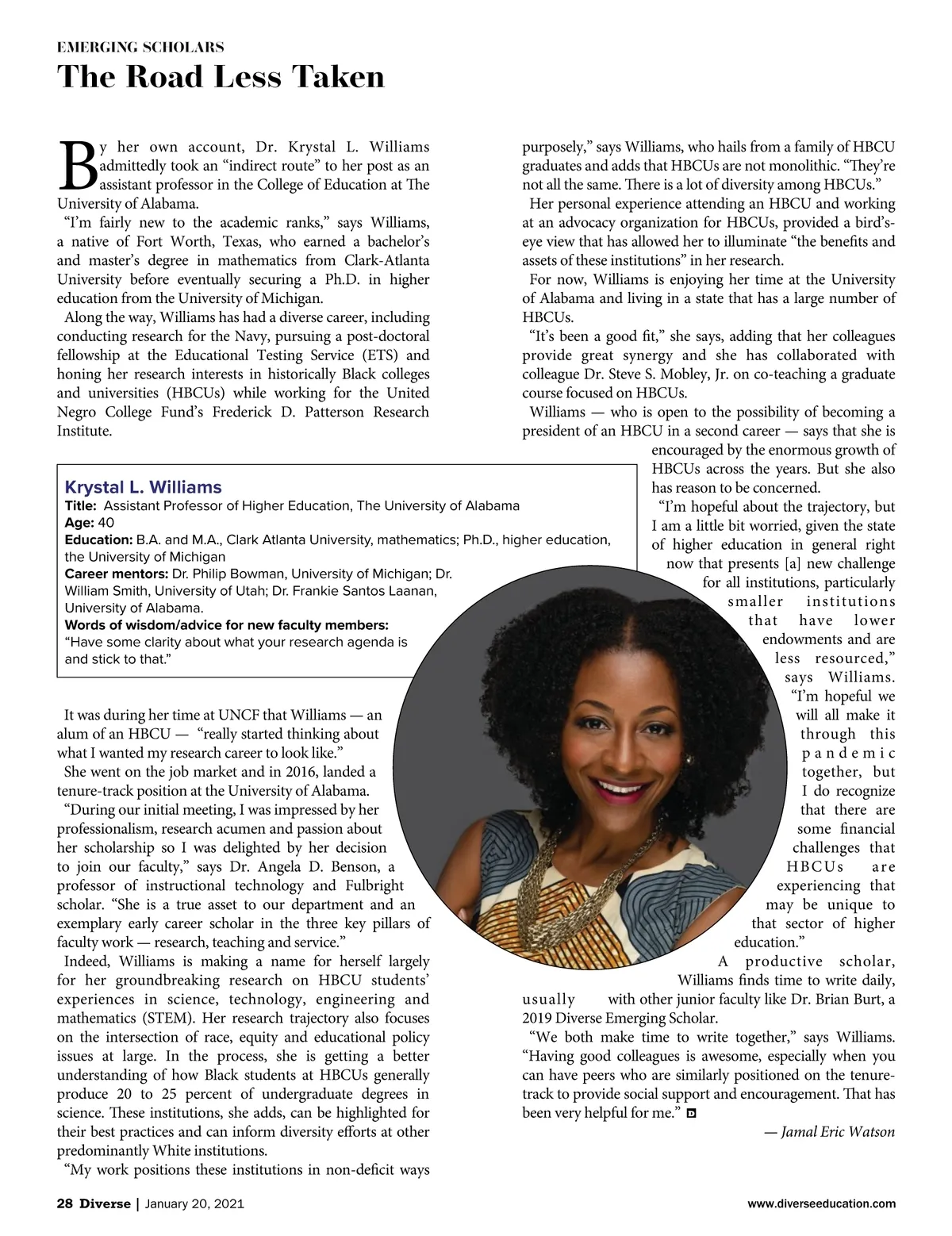
EMERGING SCHOLARS The Road Less Taken B y her own account, Dr. Krystal L. Williams admittedly took an “indirect route” to her post as an assistant professor in the College of Education at The University of Alabama. “I’m fairly new to the academic ranks,” says Williams, a native of Fort Worth, Texas, who earned a bachelor’s and master’s degree in mathematics from Clark-Atlanta University before eventually securing a Ph.D. in higher education from the University of Michigan. Along the way, Williams has had a diverse career, including conducting research for the Navy, pursuing a post-doctoral fellowship at the Educational Testing Service (ETS) and honing her research interests in historically Black colleges and universities (HBCUs) while working for the United Negro College Fund’s Frederick D. Patterson Research Institute. purposely,” says Williams, who hails from a family of HBCU graduates and adds that HBCUs are not monolithic. “They’re not all the same. There is a lot of diversity among HBCUs.” Her personal experience attending an HBCU and working at an advocacy organization for HBCUs, provided a bird’s-eye view that has allowed her to illuminate “the benefits and assets of these institutions” in her research. For now, Williams is enjoying her time at the University of Alabama and living in a state that has a large number of HBCUs. “It’s been a good fit,” she says, adding that her colleagues provide great synergy and she has collaborated with colleague Dr. Steve S. Mobley, Jr. on co-teaching a graduate course focused on HBCUs. Williams — who is open to the possibility of becoming a president of an HBCU in a second career — says that she is encouraged by the enormous growth of HBCUs across the years. But she also has reason to be concerned. Krystal L. Williams Title: Assistant Professor of Higher Education, The University of Alabama “I’m hopeful about the trajectory, but Age: 40 I am a little bit worried, given the state Education: B.A. and M.A., Clark Atlanta University, mathematics; Ph.D., higher education, of higher education in general right the University of Michigan now that presents [a] new challenge Career mentors: Dr. Philip Bowman, University of Michigan; Dr. for all institutions, particularly William Smith, University of Utah; Dr. Frankie Santos Laanan, smaller institutions University of Alabama. that have lower Words of wisdom/advice for new faculty members: endowments and are “Have some clarity about what your research agenda is less resourced,” and stick to that.” says Williams. “I’m hopeful we It was during her time at UNCF that Williams — an will all make it alum of an HBCU — “really started thinking about through this what I wanted my research career to look like.” pandemic She went on the job market and in 2016, landed a together, but tenure-track position at the University of Alabama. I do recognize “During our initial meeting, I was impressed by her that there are professionalism, research acumen and passion about some financial her scholarship so I was delighted by her decision challenges that to join our faculty,” says Dr. Angela D. Benson, a HBCUs are professor of instructional technology and Fulbright experiencing that scholar. “She is a true asset to our department and an may be unique to exemplary early career scholar in the three key pillars of that sector of higher faculty work — research, teaching and service.” education.” Indeed, Williams is making a name for herself largely A productive scholar, for her groundbreaking research on HBCU students’ Williams finds time to write daily, experiences in science, technology, engineering and usually with other junior faculty like Dr. Brian Burt, a mathematics (STEM). Her research trajectory also focuses 2019 Diverse Emerging Scholar. on the intersection of race, equity and educational policy “We both make time to write together,” says Williams. issues at large. In the process, she is getting a better “Having good colleagues is awesome, especially when you understanding of how Black students at HBCUs generally can have peers who are similarly positioned on the tenure-produce 20 to 25 percent of undergraduate degrees in track to provide social support and encouragement. That has science. These institutions, she adds, can be highlighted for been very helpful for me.” D — Jamal Eric Watson their best practices and can inform diversity efforts at other predominantly White institutions. “My work positions these institutions in non-deficit ways www.diverseeducation.com 28 Diverse | January 20, 2021
Diverse Sample January 21, 2021 Sample: Page 28