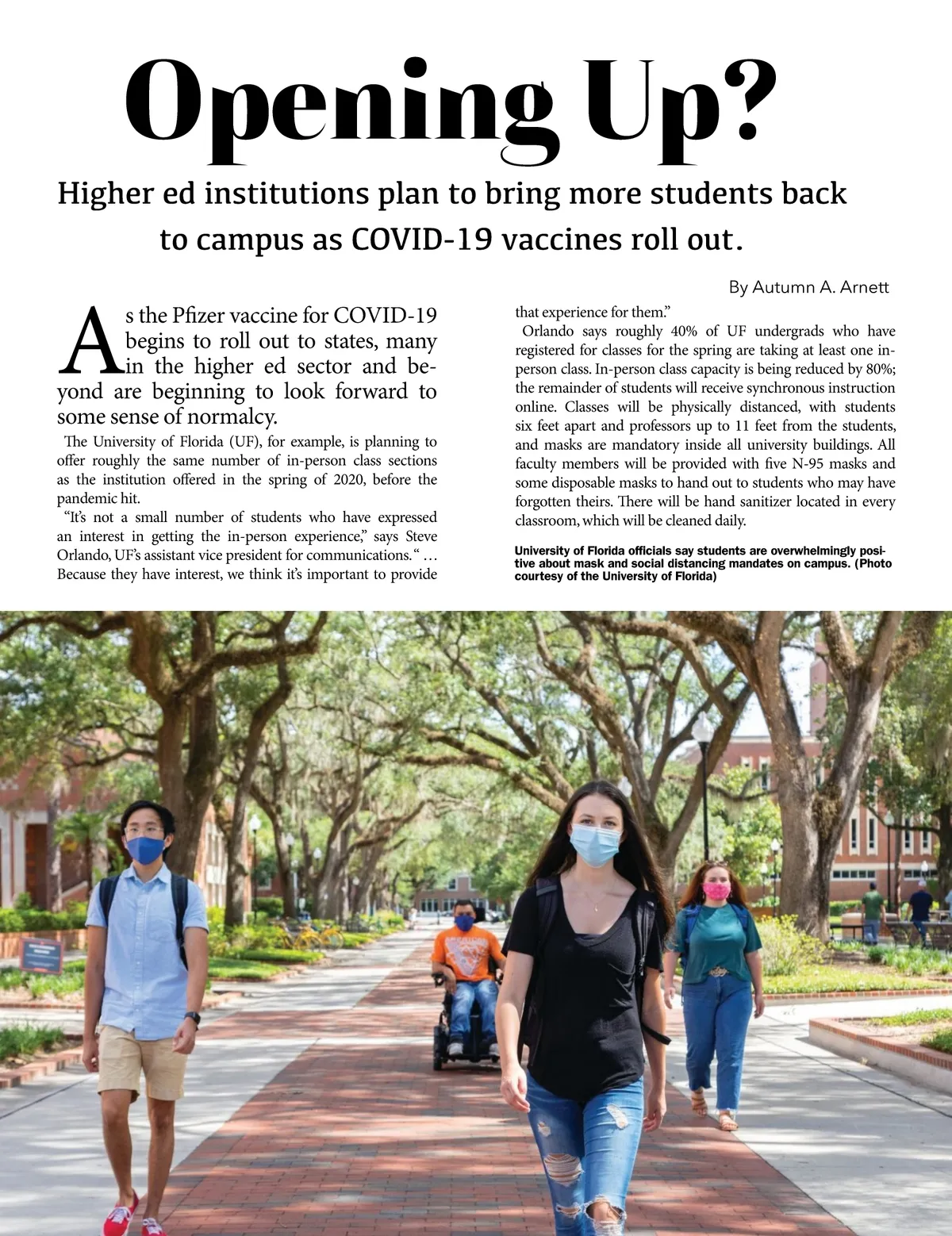
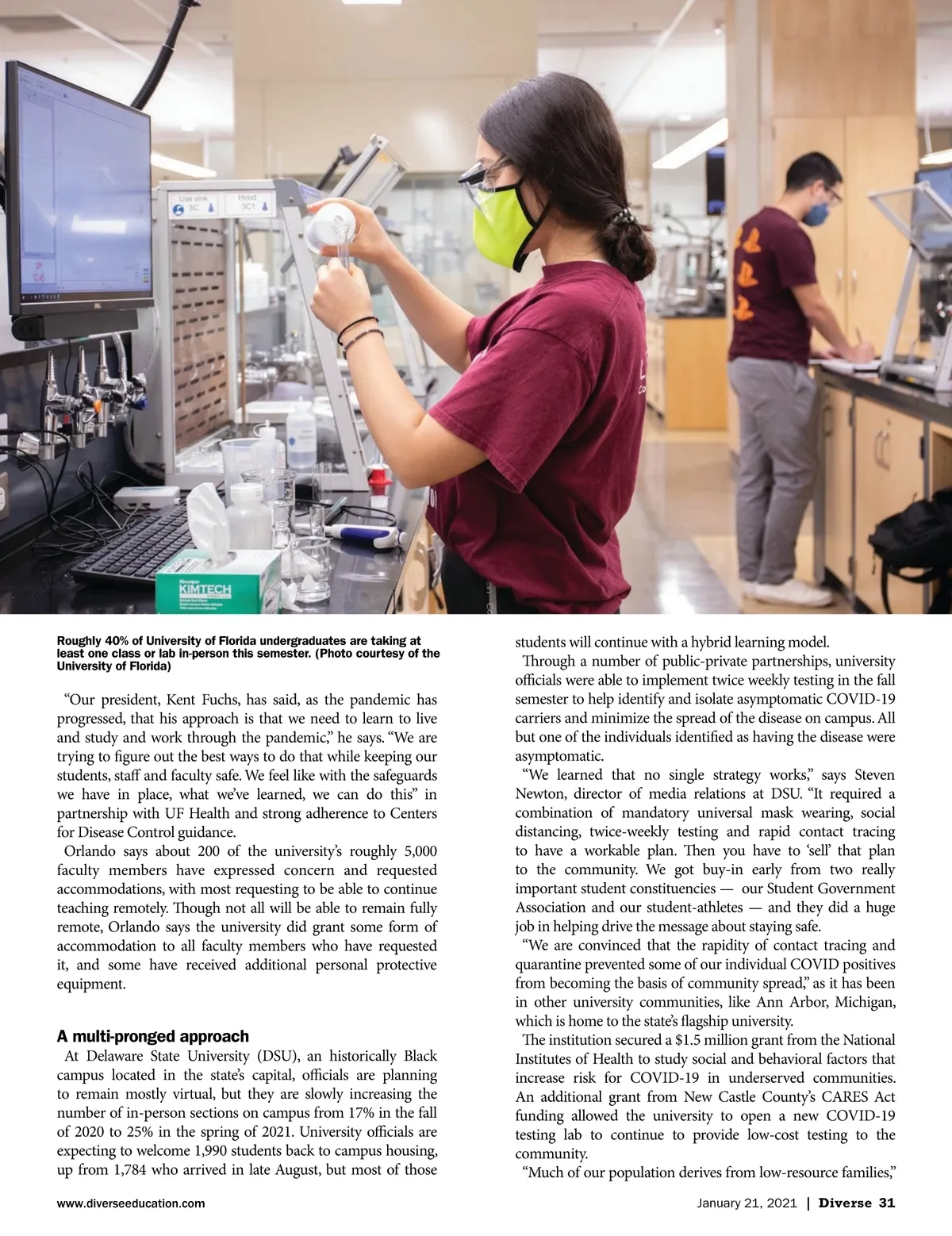
Roughly 40% of University of Florida undergraduates are taking at least one class or lab in-person this semester. (Photo courtesy of the University of Florida) “Our president, Kent Fuchs, has said, as the pandemic has progressed, that his approach is that we need to learn to live and study and work through the pandemic,” he says. “We are trying to figure out the best ways to do that while keeping our students, staff and faculty safe. We feel like with the safeguards we have in place, what we’ve learned, we can do this” in partnership with UF Health and strong adherence to Centers for Disease Control guidance. Orlando says about 200 of the university’s roughly 5,000 faculty members have expressed concern and requested accommodations, with most requesting to be able to continue teaching remotely. Though not all will be able to remain fully remote, Orlando says the university did grant some form of accommodation to all faculty members who have requested it, and some have received additional personal protective equipment. A multi-pronged approach At Delaware State University (DSU), an historically Black campus located in the state’s capital, officials are planning to remain mostly virtual, but they are slowly increasing the number of in-person sections on campus from 17% in the fall of 2020 to 25% in the spring of 2021. University officials are expecting to welcome 1,990 students back to campus housing, up from 1,784 who arrived in late August, but most of those www.diverseeducation.com students will continue with a hybrid learning model. Through a number of public-private partnerships, university officials were able to implement twice weekly testing in the fall semester to help identify and isolate asymptomatic COVID-19 carriers and minimize the spread of the disease on campus. All but one of the individuals identified as having the disease were asymptomatic. “We learned that no single strategy works,” says Steven Newton, director of media relations at DSU. “It required a combination of mandatory universal mask wearing, social distancing, twice-weekly testing and rapid contact tracing to have a workable plan. Then you have to ‘sell’ that plan to the community. We got buy-in early from two really important student constituencies — our Student Government Association and our student-athletes — and they did a huge job in helping drive the message about staying safe. “We are convinced that the rapidity of contact tracing and quarantine prevented some of our individual COVID positives from becoming the basis of community spread,” as it has been in other university communities, like Ann Arbor, Michigan, which is home to the state’s flagship university. The institution secured a $1.5 million grant from the National Institutes of Health to study social and behavioral factors that increase risk for COVID-19 in underserved communities. An additional grant from New Castle County’s CARES Act funding allowed the university to open a new COVID-19 testing lab to continue to provide low-cost testing to the community. “Much of our population derives from low-resource families,” January 21, 2021 | Diverse 31
Diverse Sample January 21, 2021 Sample: Page 31