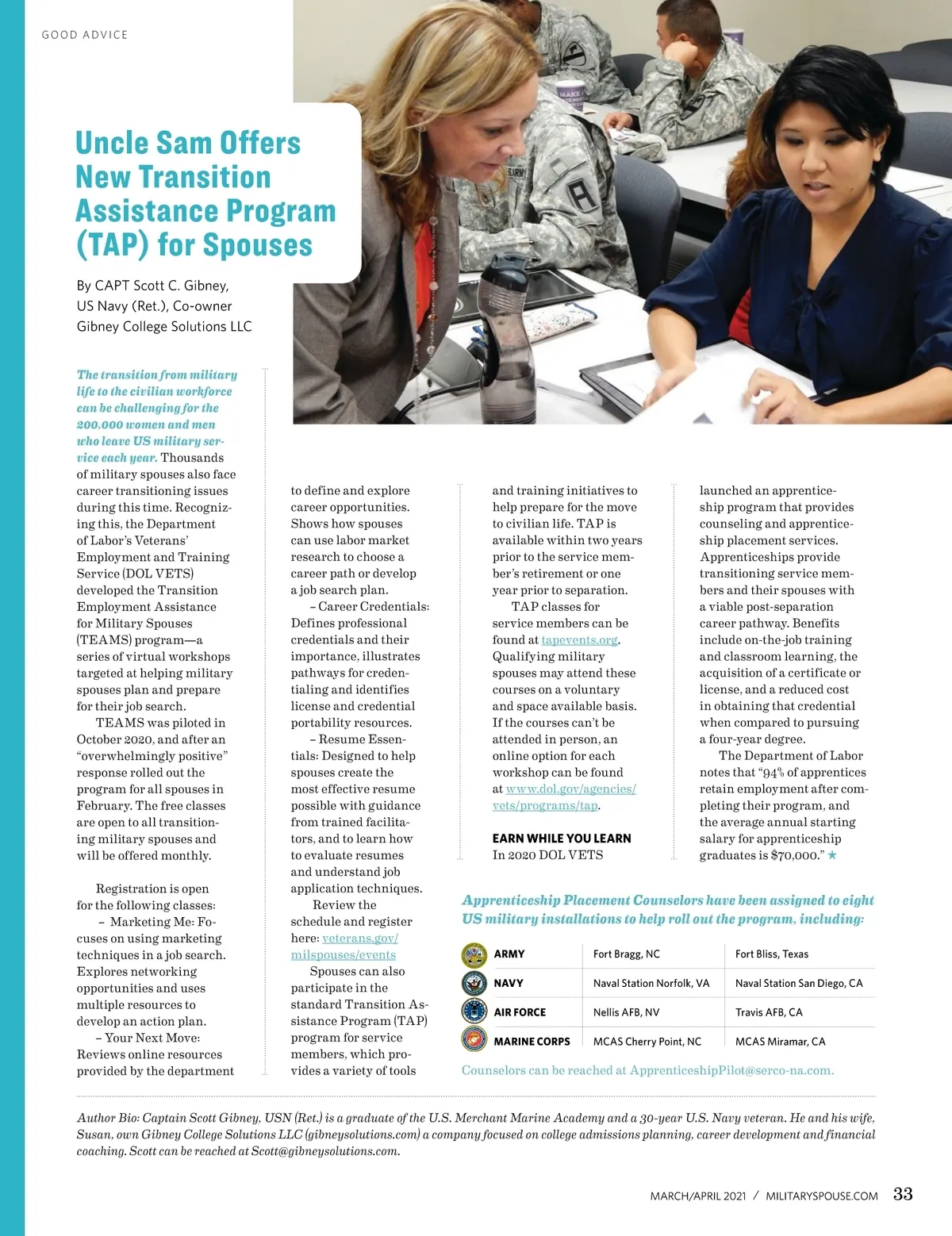
GOOD ADVICE Uncle Sam Offers New Transition Assistance Program (TAP) for Spouses By CAPT Scott C. Gibney, US Navy (Ret.), Co-owner Gibney College Solutions LLC The transition from military life to the civilian workforce can be challenging for the 200,000 women and men who leave US military ser-vice each year. Thousands of military spouses also face career transitioning issues during this time. Recogniz-ing this, the Department of Labor’s Veterans’ Employment and Training Service (DOL VETS) developed the Transition Employment Assistance for Military Spouses (TEAMS) program—a series of virtual workshops targeted at helping military spouses plan and prepare for their job search. TEAMS was piloted in October 2020, and after an “overwhelmingly positive” response rolled out the program for all spouses in February. The free classes are open to all transition-ing military spouses and will be offered monthly. Registration is open for the following classes: – Marketing Me: Fo-cuses on using marketing techniques in a job search. Explores networking opportunities and uses multiple resources to develop an action plan. – Your Next Move: Reviews online resources provided by the department to define and explore career opportunities. Shows how spouses can use labor market research to choose a career path or develop a job search plan. – Career Credentials: Defines professional credentials and their importance, illustrates pathways for creden-tialing and identifies license and credential portability resources. – Resume Essen-tials: Designed to help spouses create the most effective resume possible with guidance from trained facilita-tors, and to learn how to evaluate resumes and understand job application techniques. Review the schedule and register here: veterans.gov/ milspouses/events Spouses can also participate in the standard Transition As-sistance Program (TAP) program for service members, which pro-vides a variety of tools and training initiatives to help prepare for the move to civilian life. TAP is available within two years prior to the service mem-ber’s retirement or one year prior to separation. TAP classes for service members can be found at tapevents.org. Qualifying military spouses may attend these courses on a voluntary and space available basis. If the courses can’t be attended in person, an online option for each workshop can be found at www.dol.gov/agencies/ vets/programs/tap. EARN WHILE YOU LEARN In 2020 DOL VETS launched an apprentice-ship program that provides counseling and apprentice-ship placement services. Apprenticeships provide transitioning service mem-bers and their spouses with a viable post-separation career pathway. Benefits include on-the-job training and classroom learning, the acquisition of a certificate or license, and a reduced cost in obtaining that credential when compared to pursuing a four-year degree. The Department of Labor notes that “94% of apprentices retain employment after com-pleting their program, and the average annual starting salary for apprenticeship graduates is $70,000.” H Apprenticeship Placement Counselors have been assigned to eight US military installations to help roll out the program, including: ARMY NAVY AIR FORCE MARINE CORPS Fort Bragg, NC Naval Station Norfolk, VA Nellis AFB, NV MCAS Cherry Point, NC Fort Bliss, Texas Naval Station San Diego, CA Travis AFB, CA MCAS Miramar, CA Counselors can be reached at ApprenticeshipPilot@serco-na.com. Author Bio: Captain Scott Gibney, USN (Ret.) is a graduate of the U.S. Merchant Marine Academy and a 30-year U.S. Navy veteran. He and his wife, Susan, own Gibney College Solutions LLC (gibneysolutions.com) a company focused on college admissions planning, career development and financial coaching. Scott can be reached at Scott@gibneysolutions.com. MARCH/APRIL 2021 / MILITARYSPOUSE.COM 33
Military Spouse March/April 2021: Page 33