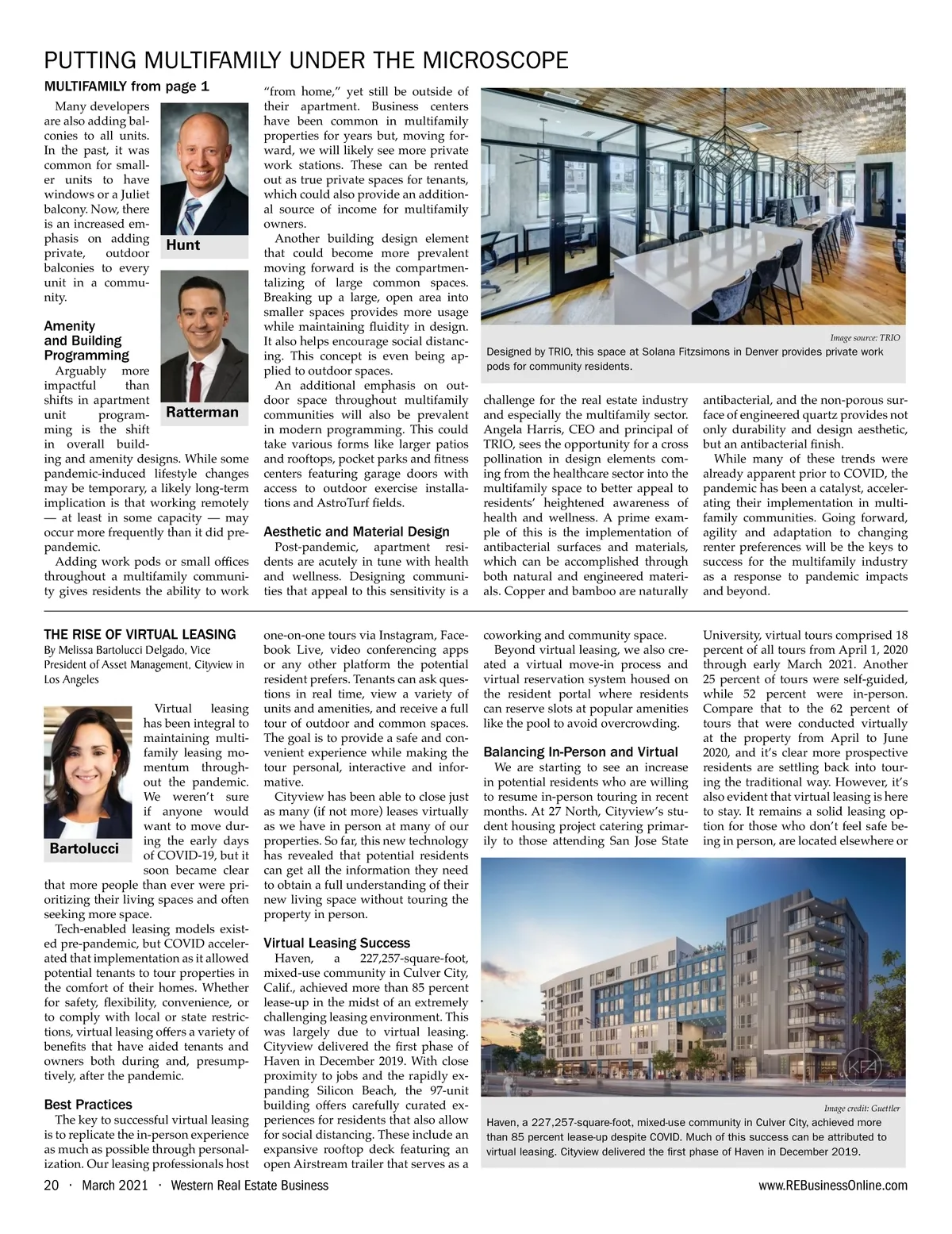
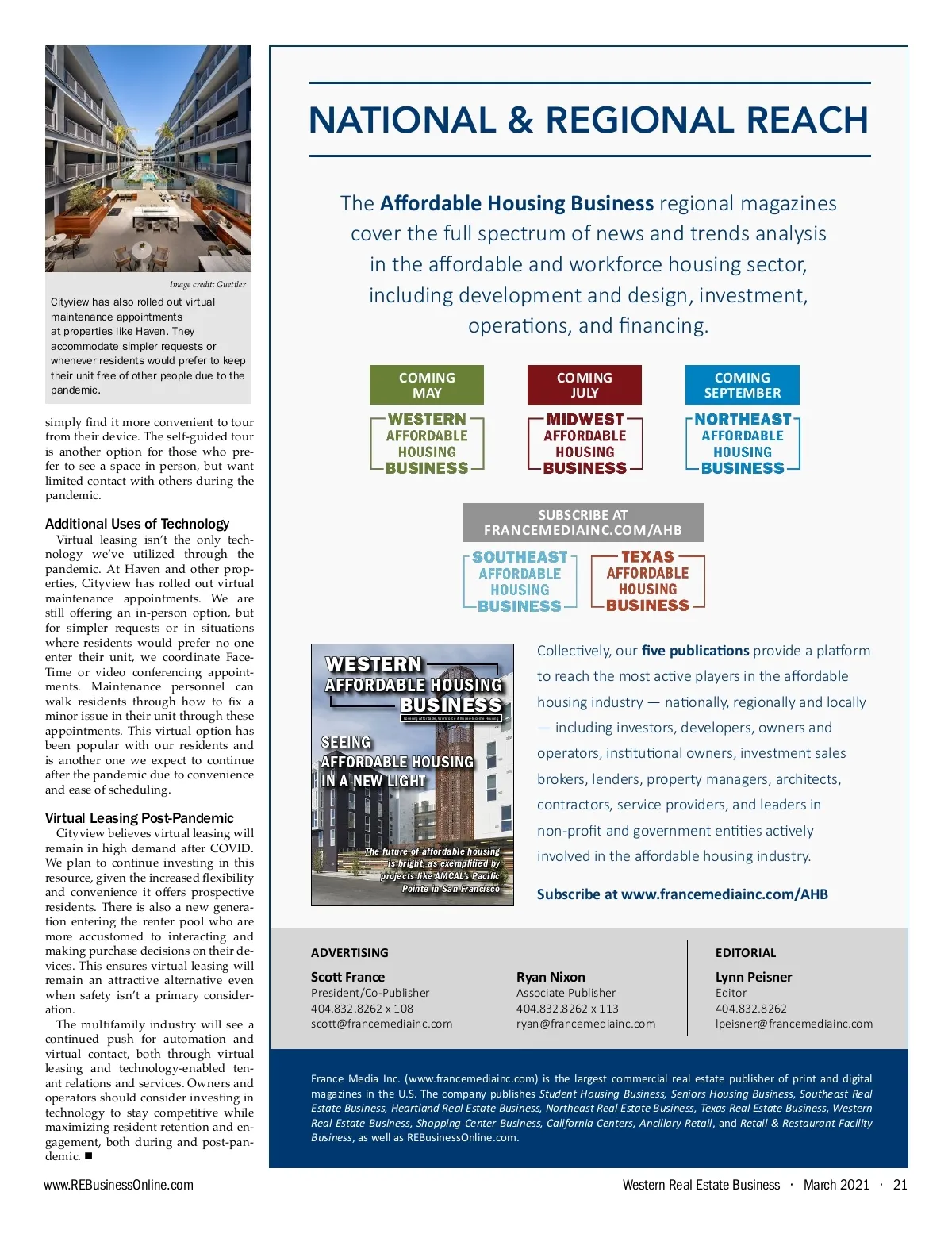
PUTTING MULTIFAMILY UNDER THE MICROSCOPE MULTIFAMILY from page 1 Many developers are also adding bal-conies to all units. In the past, it was common for small-er units to have windows or a Juliet balcony. Now, there is an increased em-phasis on adding private, outdoor balconies to every unit in a commu-nity. “from home,” yet still be outside of their apartment. Business centers have been common in multifamily properties for years but, moving for-ward, we will likely see more private work stations. These can be rented out as true private spaces for tenants, which could also provide an addition-al source of income for multifamily owners. Another building design element that could become more prevalent moving forward is the compartmen-talizing of large common spaces. Breaking up a large, open area into smaller spaces provides more usage while maintaining fluidity in design. It also helps encourage social distanc-ing. This concept is even being ap-plied to outdoor spaces. An additional emphasis on out-door space throughout multifamily communities will also be prevalent in modern programming. This could take various forms like larger patios and rooftops, pocket parks and fitness centers featuring garage doors with access to outdoor exercise installa-tions and AstroTurf fields. Hunt Amenity and Building Programming Image source: TRIO Arguably more impactful than shifts in apartment unit program-Ratterman ming is the shift in overall build-ing and amenity designs. While some pandemic-induced lifestyle changes may be temporary, a likely long-term implication is that working remotely — at least in some capacity — may occur more frequently than it did pre-pandemic. Adding work pods or small offices throughout a multifamily communi-ty gives residents the ability to work Designed by TRIO, this space at Solana Fitzsimons in Denver provides private work pods for community residents. Aesthetic and Material Design Post-pandemic, apartment resi-dents are acutely in tune with health and wellness. Designing communi-ties that appeal to this sensitivity is a one-on-one tours via Instagram, Face-book Live, video conferencing apps or any other platform the potential resident prefers. Tenants can ask ques-tions in real time, view a variety of units and amenities, and receive a full tour of outdoor and common spaces. The goal is to provide a safe and con-venient experience while making the tour personal, interactive and infor-mative. Cityview has been able to close just as many (if not more) leases virtually as we have in person at many of our properties. So far, this new technology has revealed that potential residents can get all the information they need to obtain a full understanding of their new living space without touring the property in person. challenge for the real estate industry and especially the multifamily sector. Angela Harris, CEO and principal of TRIO, sees the opportunity for a cross pollination in design elements com-ing from the healthcare sector into the multifamily space to better appeal to residents’ heightened awareness of health and wellness. A prime exam-ple of this is the implementation of antibacterial surfaces and materials, which can be accomplished through both natural and engineered materi-als. Copper and bamboo are naturally coworking and community space. Beyond virtual leasing, we also cre-ated a virtual move-in process and virtual reservation system housed on the resident portal where residents can reserve slots at popular amenities like the pool to avoid overcrowding. antibacterial, and the non-porous sur-face of engineered quartz provides not only durability and design aesthetic, but an antibacterial finish. While many of these trends were already apparent prior to COVID, the pandemic has been a catalyst, acceler-ating their implementation in multi-family communities. Going forward, agility and adaptation to changing renter preferences will be the keys to success for the multifamily industry as a response to pandemic impacts and beyond. University, virtual tours comprised 18 percent of all tours from April 1, 2020 through early March 2021. Another 25 percent of tours were self-guided, while 52 percent were in-person. Compare that to the 62 percent of tours that were conducted virtually at the property from April to June 2020, and it’s clear more prospective residents are settling back into tour-ing the traditional way. However, it’s also evident that virtual leasing is here to stay. It remains a solid leasing op-tion for those who don’t feel safe be-ing in person, are located elsewhere or THE RISE OF VIRTUAL LEASING By Melissa Bartolucci Delgado, Vice President of Asset Management, Cityview in Los Angeles Virtual leasing has been integral to maintaining multi-family leasing mo-mentum through-out the pandemic. We weren’t sure if anyone would want to move dur-ing the early days Bartolucci of COVID-19, but it soon became clear that more people than ever were pri-oritizing their living spaces and often seeking more space. Tech-enabled leasing models exist-ed pre-pandemic, but COVID acceler-ated that implementation as it allowed potential tenants to tour properties in the comfort of their homes. Whether for safety, flexibility, convenience, or to comply with local or state restric-tions, virtual leasing offers a variety of benefits that have aided tenants and owners both during and, presump-tively, after the pandemic. Balancing In-Person and Virtual We are starting to see an increase in potential residents who are willing to resume in-person touring in recent months. At 27 North, Cityview’s stu-dent housing project catering primar-ily to those attending San Jose State Virtual Leasing Success Best Practices The key to successful virtual leasing is to replicate the in-person experience as much as possible through personal-ization. Our leasing professionals host Haven, a 227,257-square-foot, mixed-use community in Culver City, Calif., achieved more than 85 percent lease-up in the midst of an extremely challenging leasing environment. This was largely due to virtual leasing. Cityview delivered the first phase of Haven in December 2019. With close proximity to jobs and the rapidly ex-panding Silicon Beach, the 97-unit building offers carefully curated ex -periences for residents that also allow for social distancing. These include an expansive rooftop deck featuring an open Airstream trailer that serves as a Image credit: Guettler Haven, a 227,257-square-foot, mixed-use community in Culver City, achieved more than 85 percent lease-up despite COVID. Much of this success can be attributed to virtual leasing. Cityview delivered the first phase of Haven in December 2019. 20 • March 2021 • Western Real Estate Business www.REBusinessOnline.com
Western Real Estate Business March 2021: Page 20