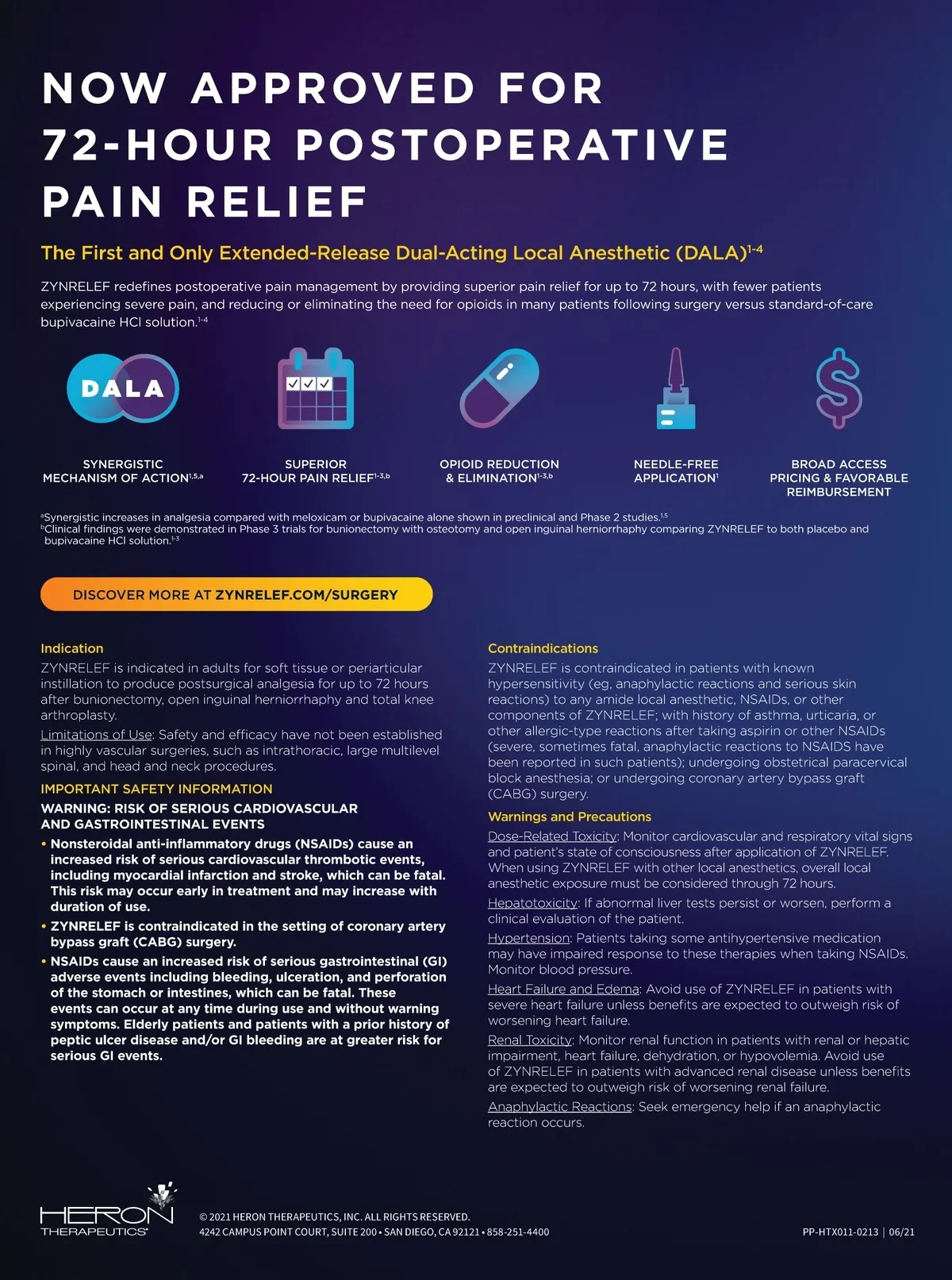
NOW APPROVED FOR 72-HOUR POSTOPERATIVE PAIN RELIEF The First and Only Extended-Release Dual-Acting Local Anesthetic (DALA) 1-4 ZYNRELEF redefines postoperative pain management by providing superior pain relief for up to 72 hours, with fewer patients experiencing severe pain, and reducing or eliminating the need for opioids in many patients following surgery versus standard-of-care bupivacaine HCl solution. 1-4 SYNERGISTIC MECHANISM OF ACTION 1,5,a SUPERIOR 72-HOUR PAIN RELIEF 1-3,b OPIOID REDUCTION & ELIMINATION 1-3,b NEEDLE-FREE APPLICATION 1 BROAD ACCESS PRICING & FAVORABLE REIMBURSEMENT a b Synergistic increases in analgesia compared with meloxicam or bupivacaine alone shown in preclinical and Phase 2 studies. 1,5 Clinical findings were demonstrated in Phase 3 trials for bunionectomy with osteotomy and open inguinal herniorrhaphy comparing ZYNRELEF to both placebo and bupivacaine HCl solution. 1-3 DISCOVER MORE AT ZYNRELEF.COM/SURGERY Indication ZYNRELEF is indicated in adults for soft tissue or periarticular instillation to produce postsurgical analgesia for up to 72 hours after bunionectomy, open inguinal herniorrhaphy and total knee arthroplasty. Limitations of Use: Safety and efficacy have not been established in highly vascular surgeries, such as intrathoracic, large multilevel spinal, and head and neck procedures. IMPORTANT SAFETY INFORMATION WARNING: RISK OF SERIOUS CARDIOVASCULAR AND GASTROINTESTINAL EVENTS • Nonsteroidal anti-inflammatory drugs (NSAIDs) cause an increased risk of serious cardiovascular thrombotic events, including myocardial infarction and stroke, which can be fatal. This risk may occur early in treatment and may increase with duration of use. • ZYNRELEF is contraindicated in the setting of coronary artery bypass graft (CABG) surgery. • NSAIDs cause an increased risk of serious gastrointestinal (GI) adverse events including bleeding, ulceration, and perforation of the stomach or intestines, which can be fatal. These events can occur at any time during use and without warning symptoms. Elderly patients and patients with a prior history of peptic ulcer disease and/or GI bleeding are at greater risk for serious GI events. Contraindications ZYNRELEF is contraindicated in patients with known hypersensitivity (eg, anaphylactic reactions and serious skin reactions) to any amide local anesthetic, NSAIDs, or other components of ZYNRELEF; with history of asthma, urticaria, or other allergic-type reactions after taking aspirin or other NSAIDs (severe, sometimes fatal, anaphylactic reactions to NSAIDS have been reported in such patients); undergoing obstetrical paracervical block anesthesia; or undergoing coronary artery bypass graft (CABG) surgery. Warnings and Precautions Dose-Related Toxicity: Monitor cardiovascular and respiratory vital signs and patient’s state of consciousness after application of ZYNRELEF. When using ZYNRELEF with other local anesthetics, overall local anesthetic exposure must be considered through 72 hours. Hepatotoxicity: If abnormal liver tests persist or worsen, perform a clinical evaluation of the patient. Hypertension: Patients taking some antihypertensive medication may have impaired response to these therapies when taking NSAIDs. Monitor blood pressure. Heart Failure and Edema: Avoid use of ZYNRELEF in patients with severe heart failure unless benefits are expected to outweigh risk of worsening heart failure. Renal Toxicity: Monitor renal function in patients with renal or hepatic impairment, heart failure, dehydration, or hypovolemia. Avoid use of ZYNRELEF in patients with advanced renal disease unless benefits are expected to outweigh risk of worsening renal failure. Anaphylactic Reactions: Seek emergency help if an anaphylactic reaction occurs. Ҷспср  �f;  �a;Ѷ�a;�f;ѵ�d;�d; �a;   ѵ усус�e; �a;�f;  Ѷ�a;сппғ�f;�a; ѶшсрсрғчфчҊсфрҊуупп Ҋ пррҊпсртҞпхҝср
Journal of the American College of Surgeons August 2021: Cover 2