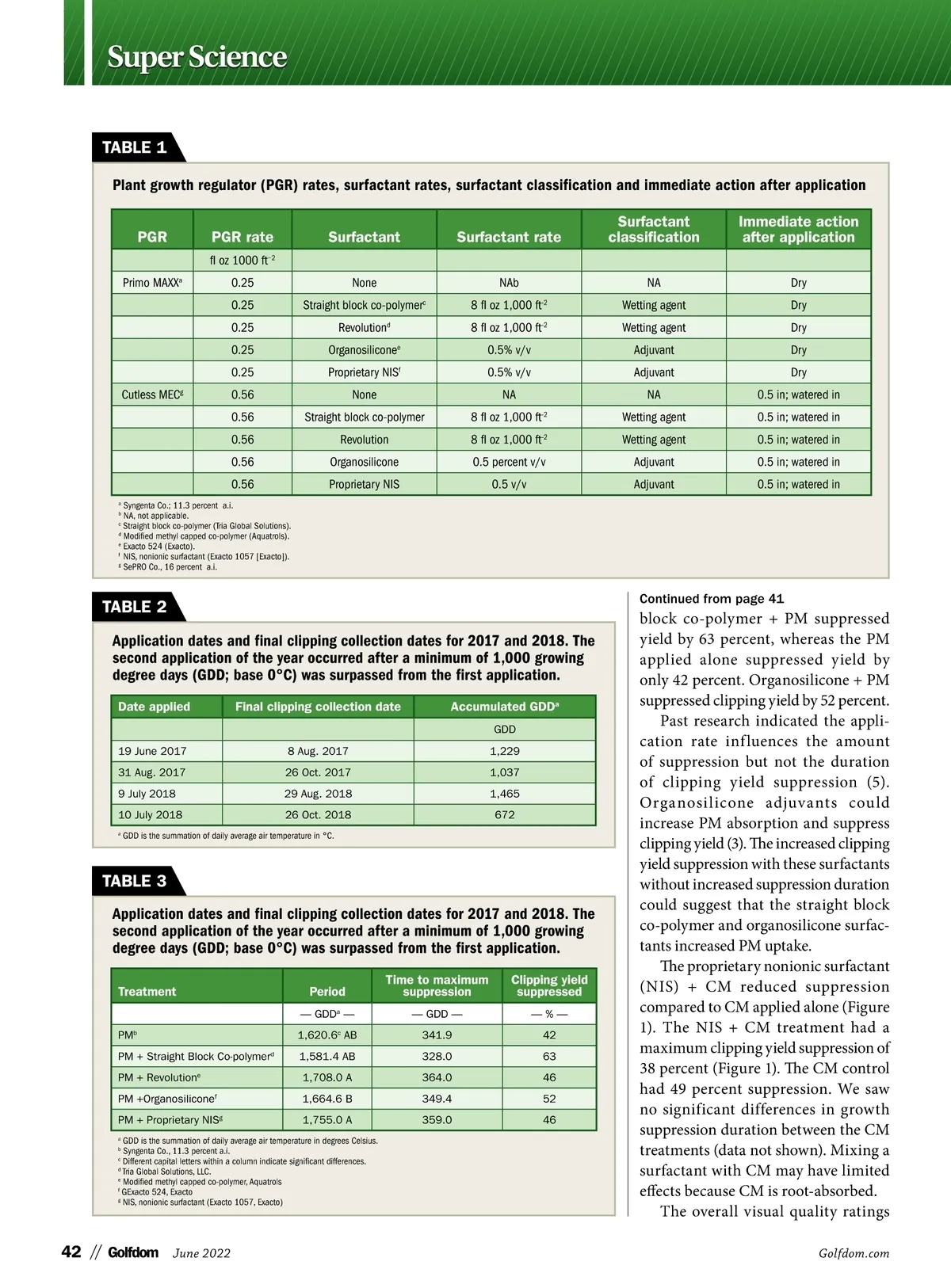
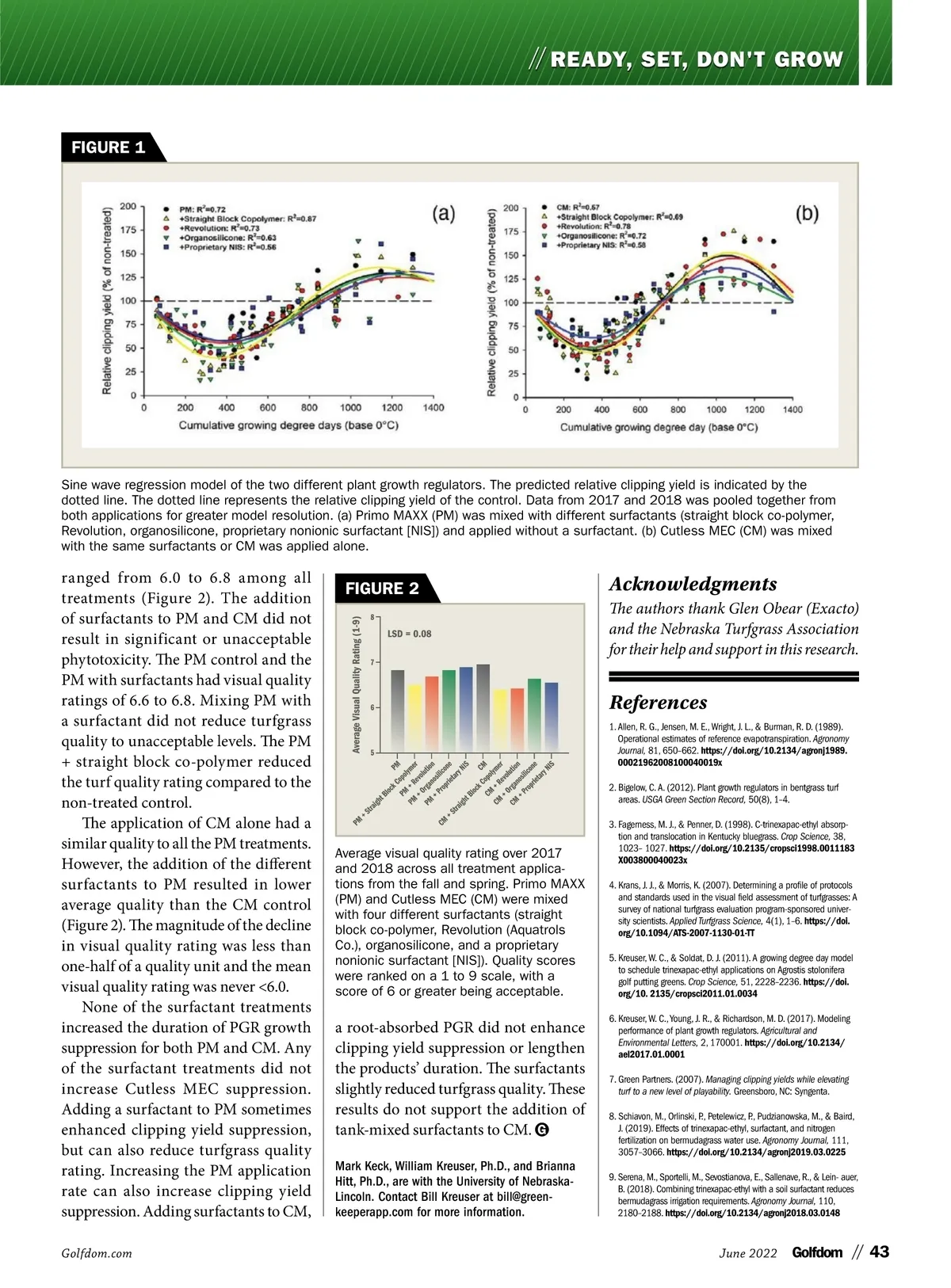
// READY, SET, DON'T FIGURE 1 GROW Sine wave regression model of the two different plant growth regulators. The predicted relative clipping yield is indicated by the dotted line. The dotted line represents the relative clipping yield of the control. Data from 2017 and 2018 was pooled together from both applications for greater model resolution. (a) Primo MAXX (PM) was mixed with different surfactants (straight block co-polymer, Revolution, organosilicone, proprietary nonionic surfactant [NIS]) and applied without a surfactant. (b) Cutless MEC (CM) was mixed with the same surfactants or CM was applied alone. ranged from 6.0 to 6.8 among all treatments (Figure 2). The addition of surfactants to PM and CM did not result in significant or unacceptable phytotoxicity. The PM control and the PM with surfactants had visual quality ratings of 6.6 to 6.8. Mixing PM with a surfactant did not reduce turfgrass quality to unacceptable levels. The PM + straight block co-polymer reduced the turf quality rating compared to the non-treated control. The application of CM alone had a similar quality to all the PM treatments. However, the addition of the different surfactants to PM resulted in lower average quality than the CM control (Figure 2). The magnitude of the decline in visual quality rating was less than one-half of a quality unit and the mean visual quality rating was never <6.0. None of the surfactant treatments increased the duration of PGR growth suppression for both PM and CM. Any of the surfactant treatments did not increase Cutless MEC suppression. Adding a surfactant to PM sometimes enhanced clipping yield suppression, but can also reduce turfgrass quality rating. Increasing the PM application rate can also increase clipping yield suppression. Adding surfactants to CM, Golfdom.com FIGURE 2 Average Visual Quality Rating (1-9) 8 Acknowledgments The authors thank Glen Obear (Exacto) and the Nebraska Turfgrass Association for their help and support in this research. LSD = 0.08 7 6 References + Re r + Organosilicon volution PM + Proprietary CM Copolymer PM Copolyme + Re + Organosilicone volution NI S e NIS 5 1. Allen, R. G., Jensen, M. E., Wright, J. L., & Burman, R. D. (1989). Operational estimates of reference evapotranspiration. Agronomy Journal, 81, 650–662. https://doi.org/10.2134/agronj1989. 00021962008100040019x 2. Bigelow, C. A. (2012). Plant growth regulators in bentgrass turf areas. USGA Green Section Record, 50(8), 1–4. 3. Fagerness, M. J., & Penner, D. (1998). C-trinexapac-ethyl absorp-tion and translocation in Kentucky bluegrass. Crop Science, 38, 1023– 1027. https://doi.org/10.2135/cropsci1998.0011183 X003800040023x 4. Krans, J. J., & Morris, K. (2007). Determining a profile of protocols and standards used in the visual field assessment of turfgrasses: A survey of national turfgrass evaluation program-sponsored univer-sity scientists. Applied Turfgrass Science, 4(1), 1–6. https://doi. org/10.1094/ATS-2007-1130-01-TT 5. Kreuser, W. C., & Soldat, D. J. (2011). A growing degree day model to schedule trinexapac-ethyl applications on Agrostis stolonifera golf putting greens. Crop Science, 51, 2228–2236. https://doi. org/10. 2135/cropsci2011.01.0034 6. Kreuser, W. C., Young, J. R., & Richardson, M. D. (2017). Modeling performance of plant growth regulators. Agricultural and Environmental Letters, 2, 170001. https://doi.org/10.2134/ ael2017.01.0001 7. Green Partners. (2007). Managing clipping yields while elevating turf to a new level of playability. Greensboro, NC: Syngenta. 8. Schiavon, M., Orlinski, P., Petelewicz, P ., Pudzianowska, M., & Baird, J. (2019). Effects of trinexapac-ethyl, surfactant, and nitrogen fertilization on bermudagrass water use. Agronomy Journal, 111, 3057–3066. https://doi.org/10.2134/agronj2019.03.0225 9. Serena, M., Sportelli, M., Sevostianova, E., Sallenave, R., & Lein-auer, B. (2018). Combining trinexapac-ethyl with a soil surfactant reduces bermudagrass irrigation requirements. Agronomy Journal, 110, 2180–2188. https://doi.org/10.2134/agronj2018.03.0148 + Straight + Straight PM CM Average visual quality rating over 2017 and 2018 across all treatment applica-tions from the fall and spring. Primo MAXX (PM) and Cutless MEC (CM) were mixed with four different surfactants (straight block co-polymer, Revolution (Aquatrols Co.), organosilicone, and a proprietary nonionic surfactant [NIS]). Quality scores were ranked on a 1 to 9 scale, with a score of 6 or greater being acceptable. a root-absorbed PGR did not enhance clipping yield suppression or lengthen the products’ duration. The surfactants slightly reduced turfgrass quality. These results do not support the addition of tank-mixed surfactants to CM. G Mark Keck, William Kreuser, Ph.D., and Brianna Hitt, Ph.D., are with the University of Nebraska-Lincoln. Contact Bill Kreuser at bill@green-keeperapp.com for more information. CM PM CM + Proprietary Block Block PM CM June 2022 Golfdom // 43
Golfdom June 2022: Page-43