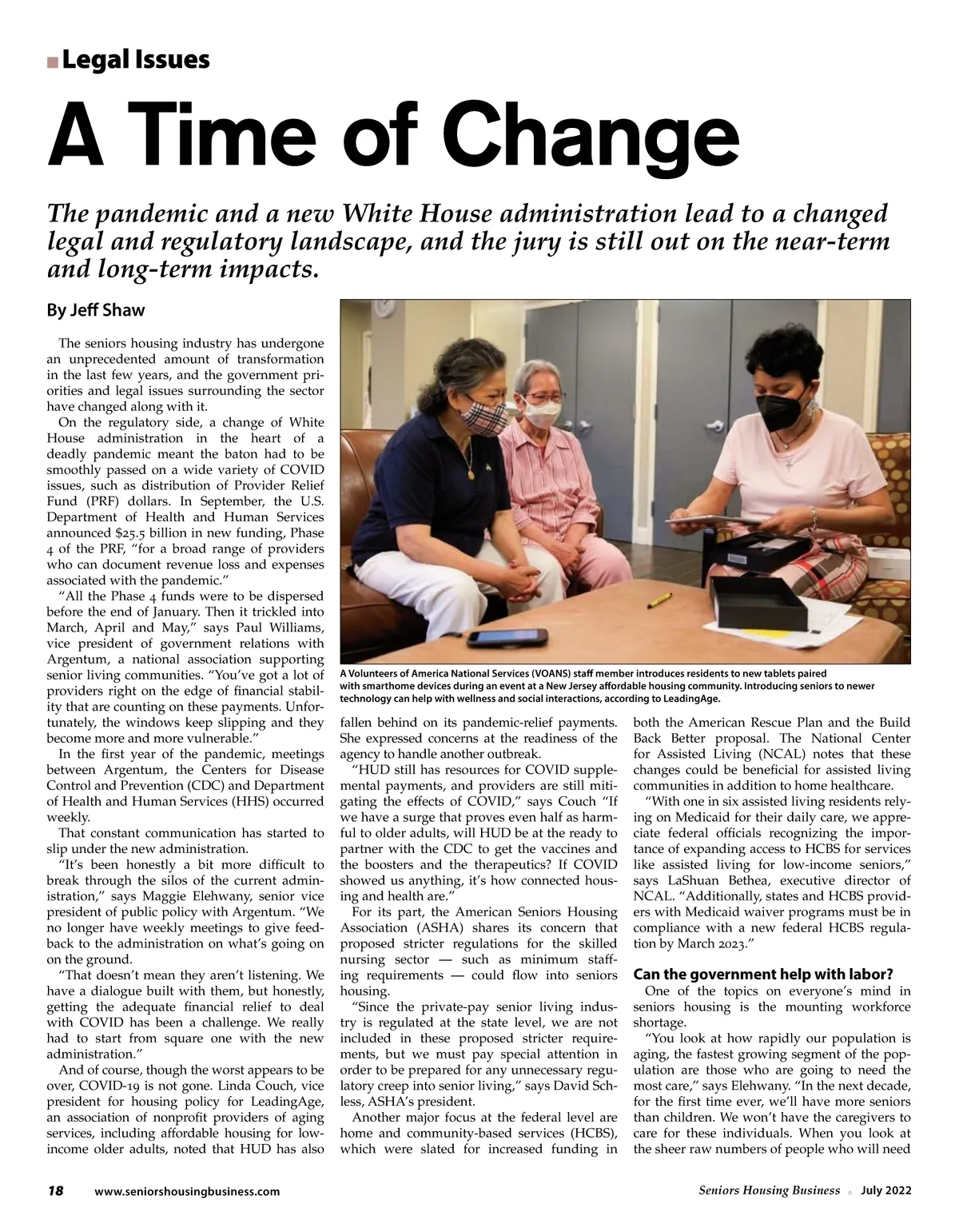
n Legal Issues A Time of Change The pandemic and a new White House administration lead to a changed legal and regulatory landscape, and the jury is still out on the near-term and long-term impacts. By Jeff Shaw The seniors housing industry has undergone an unprecedented amount of transformation in the last few years, and the government pri-orities and legal issues surrounding the sector have changed along with it. On the regulatory side, a change of White House administration in the heart of a deadly pandemic meant the baton had to be smoothly passed on a wide variety of COVID issues, such as distribution of Provider Relief Fund (PRF) dollars. In September, the U.S. Department of Health and Human Services announced $25.5 billion in new funding, Phase 4 of the PRF, “for a broad range of providers who can document revenue loss and expenses associated with the pandemic.” “All the Phase 4 funds were to be dispersed before the end of January. Then it trickled into March, April and May,” says Paul Williams, vice president of government relations with Argentum, a national association supporting senior living communities. “You’ve got a lot of providers right on the edge of financial stabil-ity that are counting on these payments. Unfor-tunately, the windows keep slipping and they become more and more vulnerable.” In the first year of the pandemic, meetings between Argentum, the Centers for Disease Control and Prevention (CDC) and Department of Health and Human Services (HHS) occurred weekly. That constant communication has started to slip under the new administration. “It’s been honestly a bit more difficult to break through the silos of the current admin-istration,” says Maggie Elehwany, senior vice president of public policy with Argentum. “We no longer have weekly meetings to give feed-back to the administration on what’s going on on the ground. “That doesn’t mean they aren’t listening. We have a dialogue built with them, but honestly, getting the adequate financial relief to deal with COVID has been a challenge. We really had to start from square one with the new administration.” And of course, though the worst appears to be over, COVID-19 is not gone. Linda Couch, vice president for housing policy for LeadingAge, an association of nonprofit providers of aging services, including affordable housing for low-income older adults, noted that HUD has also A Volunteers of America National Services (VOANS) staff member introduces residents to new tablets paired with smarthome devices during an event at a New Jersey affordable housing community. Introducing seniors to newer technology can help with wellness and social interactions, according to LeadingAge. fallen behind on its pandemic-relief payments. She expressed concerns at the readiness of the agency to handle another outbreak. “HUD still has resources for COVID supple-mental payments, and providers are still miti-gating the effects of COVID,” says Couch “If we have a surge that proves even half as harm-ful to older adults, will HUD be at the ready to partner with the CDC to get the vaccines and the boosters and the therapeutics? If COVID showed us anything, it’s how connected hous-ing and health are.” For its part, the American Seniors Housing Association (ASHA) shares its concern that proposed stricter regulations for the skilled nursing sector — such as minimum staff-ing requirements — could flow into seniors housing. “Since the private-pay senior living indus-try is regulated at the state level, we are not included in these proposed stricter require-ments, but we must pay special attention in order to be prepared for any unnecessary regu-latory creep into senior living,” says David Sch-less, ASHA’s president. Another major focus at the federal level are home and community-based services (HCBS), which were slated for increased funding in both the American Rescue Plan and the Build Back Better proposal. The National Center for Assisted Living (NCAL) notes that these changes could be beneficial for assisted living communities in addition to home healthcare. “With one in six assisted living residents rely-ing on Medicaid for their daily care, we appre-ciate federal officials recognizing the impor-tance of expanding access to HCBS for services like assisted living for low-income seniors,” says LaShuan Bethea, executive director of NCAL. “Additionally, states and HCBS provid-ers with Medicaid waiver programs must be in compliance with a new federal HCBS regula-tion by March 2023.” Can the government help with labor? One of the topics on everyone’s mind in seniors housing is the mounting workforce shortage. “You look at how rapidly our population is aging, the fastest growing segment of the pop-ulation are those who are going to need the most care,” says Elehwany. “In the next decade, for the first time ever, we’ll have more seniors than children. We won’t have the caregivers to care for these individuals. When you look at the sheer raw numbers of people who will need Seniors Housing Business n 18 www.seniorshousingbusiness.com July 2022
Seniors Housing Business July 2022: Page 18