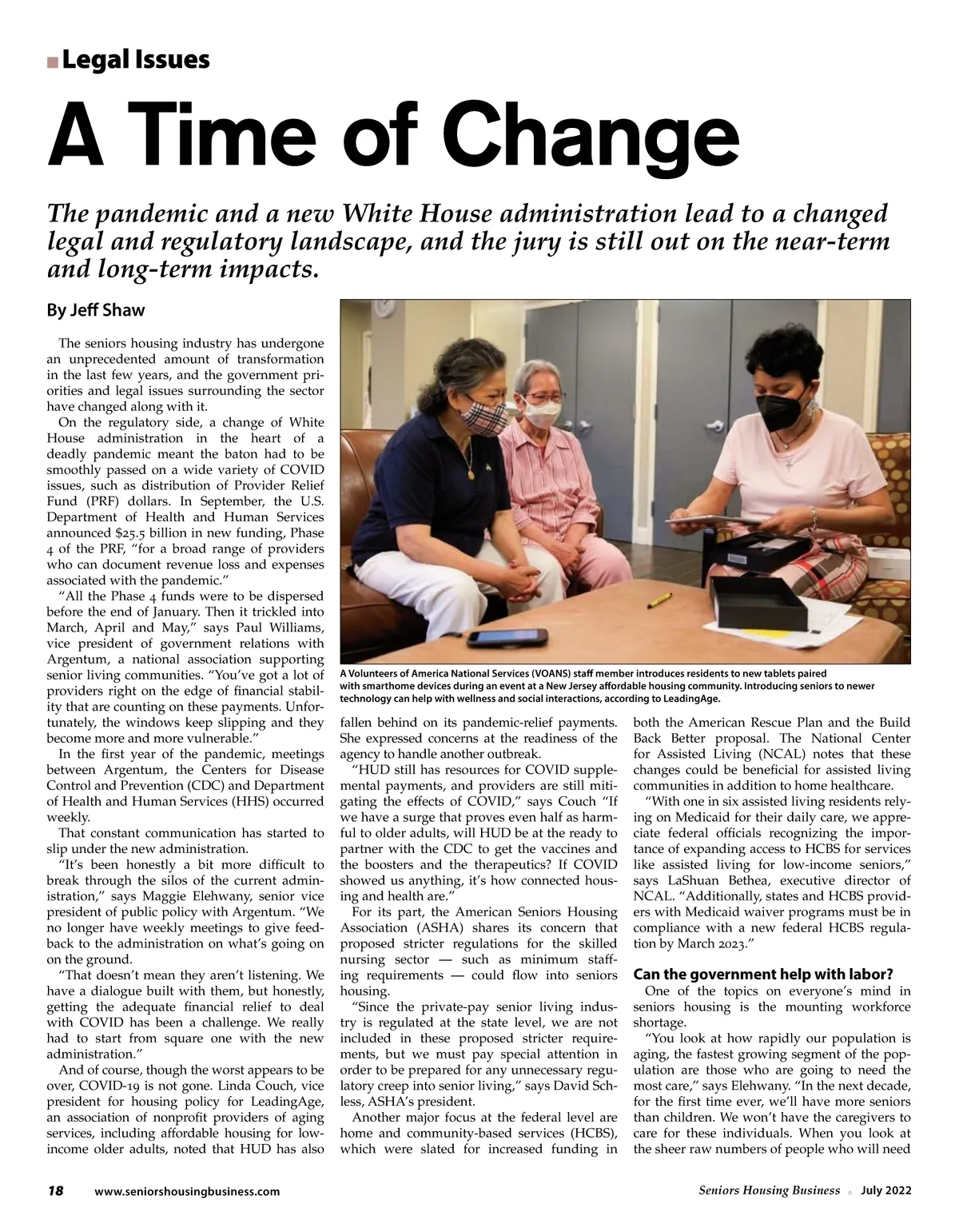
aid and the size of the workforce, all the other crises pale in comparison.” Nearly three-fourths of nursing homes and more than half of assisted living communities report that their overall workforce situation has worsened over the past year, according to a June 2021 study by NCAL. Operators need to have their own hiring and recruitment strategies, but in what ways could government programs assist? “Our industry is facing a historic workforce crisis that has impacted virtually every aspect of the business in negative ways,” says Schless. “Therefore, we actively engage with policy-makers in both parties to try and find solutions. We need thousands of additional caregivers and other essential community-level person-nel, including med techs, food servers and housekeepers.” Argentum notes that several successful pro-grams already exist — they just need to be expanded. “You don’t need to reinvent the wheel, you just need to focus some programs that the fed-eral government offers now,” says Elehwany. “Argentum’s goal is to really set forth a plat-form. The problem is so significant there’s no one silver bullet.” Argentum specifically cites the Health Apprenticeship Expansion Program through the Department of Labor, which provides a pathway for long, successful careers. Elehwany says the program is “phenomenally successful — we just need more of it.” Other promising ideas include loan forgive-ness for college education in certain career paths that are currently underserved. “We want them to start steering the ship toward geriatric care,” says Elehwany. LeadingAge notes that immigration pro-grams could also bring in more employees from other countries through a special visa pro-gram specifically for workers in the aging ser-vices space. “We all know that there are not enough peo-ple in this country to meet the needs of today’s older adults. We all know that the older adult population is expanding every single day. We know the math doesn’t work,” says Couch. “Congress has to step up with a solution. The State Department has to be told what to do, and it needs the resources to do it.” Affordability is always a concern While the seniors housing industry must make sure the U.S. has enough workers to serve the growing senior population, it must also consider where those people will live. Making sure all seniors can afford to live in seniors housing is an ongoing challenge for the industry. “In order to meet the growing needs of the elderly population, we must look for ways to make assisted living a more affordable option for low-to moderate-income older adults who are no longer able to live at home,” says Bethea. “We are encouraging state policymak-ers to expand affordable assisted living through a variety of grants and programs.” As far as true affordable housing, with rent A resident exercises at Watchung Terrace, a Springpoint affordable housing community in Middlesex, New Jersey, which is participating in the Affordable Housing Wellness Initiative. As a result of COVID-19, internet access became key for seniors to have social and wellness outlets in their homes. and income restrictions for residents and gov-ernment incentives providing some of the costs, the common refrain for many years is that there simply isn’t enough supply. “We are singularly focused on the fact that too many older adults are living in a time of deep scarcity,” says Couch. “When inflation is pushing way past their fixed incomes when it comes to rent and life necessities, there are way too few affordable seniors housing units, and Nationally-recognized and award-winning lifestyle program Developed over 25,000 units Managed over 25,000 units Celebrating 50 Years of Senior Living... » DEVELOPMENT » INVESTMENT » MANAGEMENT » ACQUISITIONS (518) 687-7300 • www.UGOC.com July 2022 n Seniors Housing Business www.seniorshousingbusiness.com 19
Seniors Housing Business July 2022: Page 19