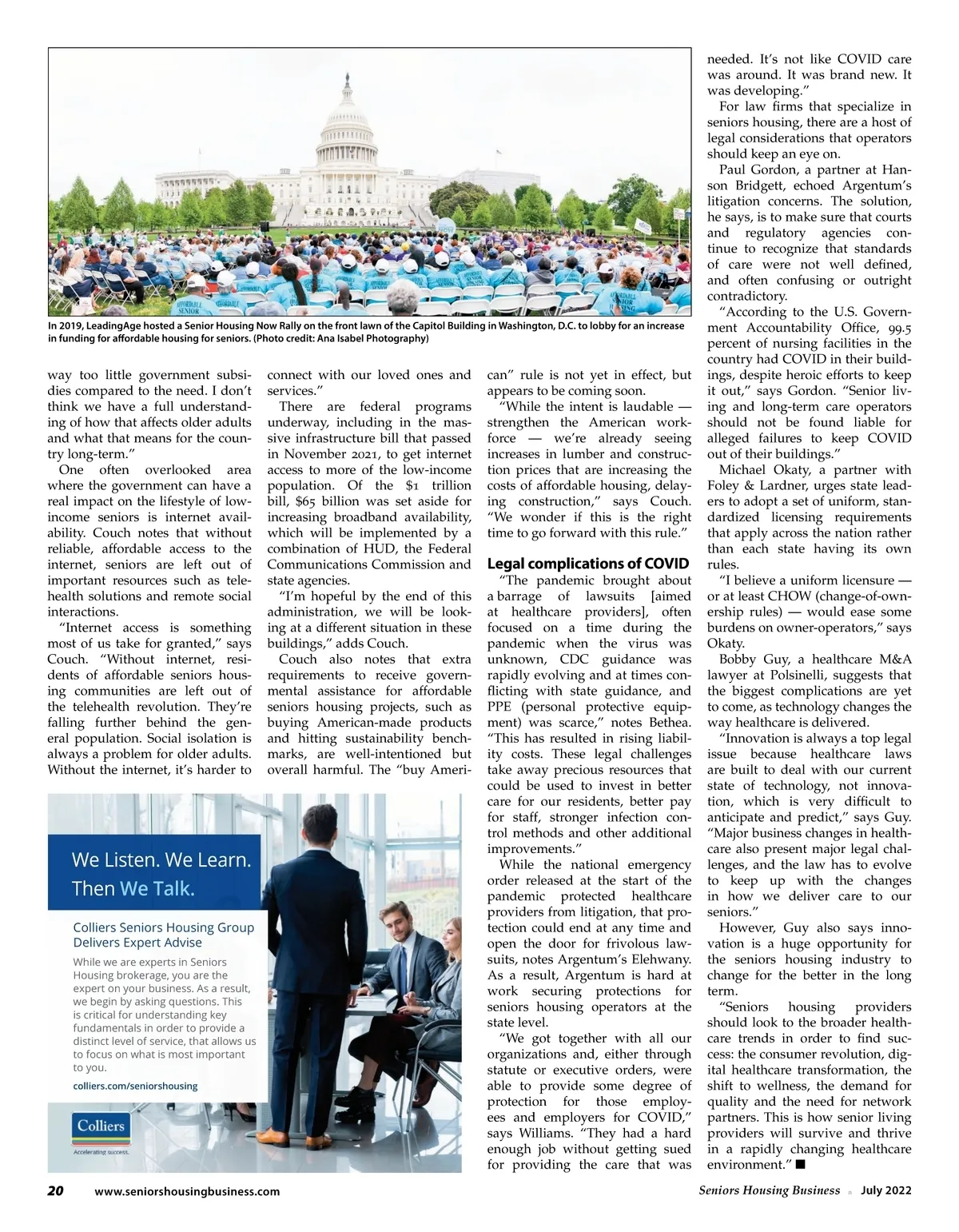
In 2019, LeadingAge hosted a Senior Housing Now Rally on the front lawn of the Capitol Building in Washington, D.C. to lobby for an increase in funding for affordable housing for seniors. (Photo credit: Ana Isabel Photography) way too little government subsi-dies compared to the need. I don’t think we have a full understand-ing of how that affects older adults and what that means for the coun-try long-term.” One often overlooked area where the government can have a real impact on the lifestyle of low-income seniors is internet avail-ability. Couch notes that without reliable, affordable access to the internet, seniors are left out of important resources such as tele-health solutions and remote social interactions. “Internet access is something most of us take for granted,” says Couch. “Without internet, resi-dents of affordable seniors hous-ing communities are left out of the telehealth revolution. They’re falling further behind the gen-eral population. Social isolation is always a problem for older adults. Without the internet, it’s harder to connect with our loved ones and services.” There are federal programs underway, including in the mas-sive infrastructure bill that passed in November 2021, to get internet access to more of the low-income population. Of the $1 trillion bill, $65 billion was set aside for increasing broadband availability, which will be implemented by a combination of HUD, the Federal Communications Commission and state agencies. “I’m hopeful by the end of this administration, we will be look-ing at a different situation in these buildings,” adds Couch. Couch also notes that extra requirements to receive govern-mental assistance for affordable seniors housing projects, such as buying American-made products and hitting sustainability bench-marks, are well-intentioned but overall harmful. The “buy Ameri-can” rule is not yet in effect, but appears to be coming soon. “While the intent is laudable — strengthen the American work-force — we’re already seeing increases in lumber and construc-tion prices that are increasing the costs of affordable housing, delay-ing construction,” says Couch. “We wonder if this is the right time to go forward with this rule.” Legal complications of COVID We Listen. We Learn. Then We Talk. Colliers Seniors Housing Group Delivers Expert Advise While we are experts in Seniors Housing brokerage, you are the expert on your business. As a result, we begin by asking questions. This is critical for understanding key fundamentals in order to provide a distinct level of service, that allows us to focus on what is most important to you. colliers.com/seniorshousing “The pandemic brought about a barrage of lawsuits [aimed at healthcare providers], often focused on a time during the pandemic when the virus was unknown, CDC guidance was rapidly evolving and at times con-flicting with state guidance, and PPE (personal protective equip-ment) was scarce,” notes Bethea. “This has resulted in rising liabil-ity costs. These legal challenges take away precious resources that could be used to invest in better care for our residents, better pay for staff, stronger infection con-trol methods and other additional improvements.” While the national emergency order released at the start of the pandemic protected healthcare providers from litigation, that pro-tection could end at any time and open the door for frivolous law-suits, notes Argentum’s Elehwany. As a result, Argentum is hard at work securing protections for seniors housing operators at the state level. “We got together with all our organizations and, either through statute or executive orders, were able to provide some degree of protection for those employ-ees and employers for COVID,” says Williams. “They had a hard enough job without getting sued for providing the care that was needed. It’s not like COVID care was around. It was brand new. It was developing.” For law firms that specialize in seniors housing, there are a host of legal considerations that operators should keep an eye on. Paul Gordon, a partner at Han-son Bridgett, echoed Argentum’s litigation concerns. The solution, he says, is to make sure that courts and regulatory agencies con-tinue to recognize that standards of care were not well defined, and often confusing or outright contradictory. “According to the U.S. Govern-ment Accountability Office, 99.5 percent of nursing facilities in the country had COVID in their build-ings, despite heroic efforts to keep it out,” says Gordon. “Senior liv-ing and long-term care operators should not be found liable for alleged failures to keep COVID out of their buildings.” Michael Okaty, a partner with Foley & Lardner, urges state lead-ers to adopt a set of uniform, stan-dardized licensing requirements that apply across the nation rather than each state having its own rules. “I believe a uniform licensure — or at least CHOW (change-of-own-ership rules) — would ease some burdens on owner-operators,” says Okaty. Bobby Guy, a healthcare M&A lawyer at Polsinelli, suggests that the biggest complications are yet to come, as technology changes the way healthcare is delivered. “Innovation is always a top legal issue because healthcare laws are built to deal with our current state of technology, not innova-tion, which is very difficult to anticipate and predict,” says Guy. “Major business changes in health-care also present major legal chal-lenges, and the law has to evolve to keep up with the changes in how we deliver care to our seniors.” However, Guy also says inno-vation is a huge opportunity for the seniors housing industry to change for the better in the long term. “Seniors housing providers should look to the broader health-care trends in order to find suc-cess: the consumer revolution, dig-ital healthcare transformation, the shift to wellness, the demand for quality and the need for network partners. This is how senior living providers will survive and thrive in a rapidly changing healthcare environment.” n Seniors Housing Business n 20 www.seniorshousingbusiness.com July 2022
Seniors Housing Business July 2022: Page 20