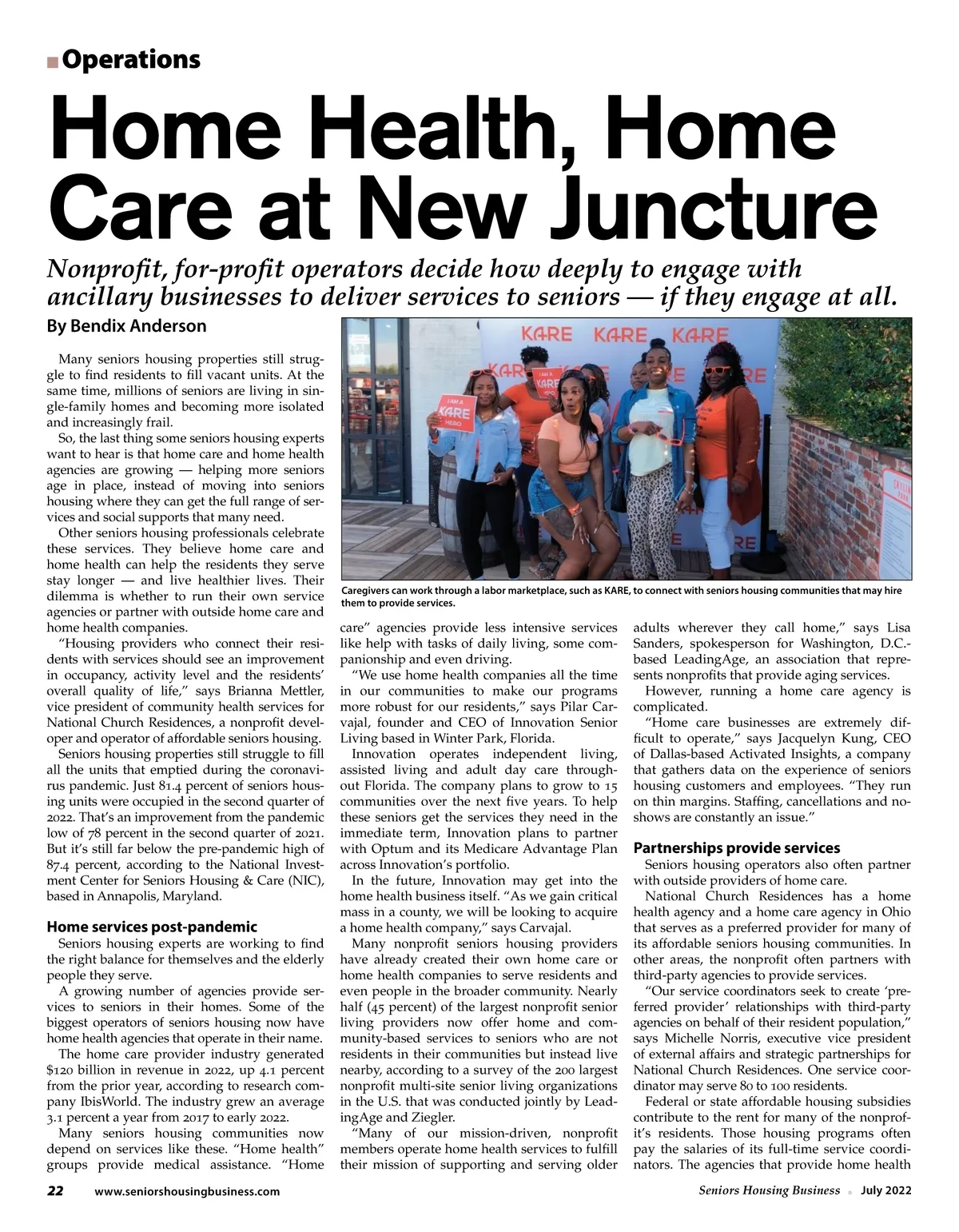
n Nonprofit, for-profit operators decide how deeply to engage with ancillary businesses to deliver services to seniors — if they engage at all. By Bendix Anderson Many seniors housing properties still strug-gle to find residents to fill vacant units. At the same time, millions of seniors are living in sin-gle-family homes and becoming more isolated and increasingly frail. So, the last thing some seniors housing experts want to hear is that home care and home health agencies are growing — helping more seniors age in place, instead of moving into seniors housing where they can get the full range of ser-vices and social supports that many need. Other seniors housing professionals celebrate these services. They believe home care and home health can help the residents they serve stay longer — and live healthier lives. Their dilemma is whether to run their own service agencies or partner with outside home care and home health companies. “Housing providers who connect their resi-dents with services should see an improvement in occupancy, activity level and the residents’ overall quality of life,” says Brianna Mettler, vice president of community health services for National Church Residences, a nonprofit devel-oper and operator of affordable seniors housing. Seniors housing properties still struggle to fill all the units that emptied during the coronavi-rus pandemic. Just 81.4 percent of seniors hous-ing units were occupied in the second quarter of 2022. That’s an improvement from the pandemic low of 78 percent in the second quarter of 2021. But it’s still far below the pre-pandemic high of 87.4 percent, according to the National Invest-ment Center for Seniors Housing & Care (NIC), based in Annapolis, Maryland. Home Health, Home Care at New Juncture Operations Caregivers can work through a labor marketplace, such as KARE, to connect with seniors housing communities that may hire them to provide services. Home services post-pandemic Seniors housing experts are working to find the right balance for themselves and the elderly people they serve. A growing number of agencies provide ser-vices to seniors in their homes. Some of the biggest operators of seniors housing now have home health agencies that operate in their name. The home care provider industry generated $120 billion in revenue in 2022, up 4.1 percent from the prior year, according to research com-pany IbisWorld. The industry grew an average 3.1 percent a year from 2017 to early 2022. Many seniors housing communities now depend on services like these. “Home health” groups provide medical assistance. “Home care” agencies provide less intensive services like help with tasks of daily living, some com-panionship and even driving. “We use home health companies all the time in our communities to make our programs more robust for our residents,” says Pilar Car-vajal, founder and CEO of Innovation Senior Living based in Winter Park, Florida. Innovation operates independent living, assisted living and adult day care through-out Florida. The company plans to grow to 15 communities over the next five years. To help these seniors get the services they need in the immediate term, Innovation plans to partner with Optum and its Medicare Advantage Plan across Innovation’s portfolio. In the future, Innovation may get into the home health business itself. “As we gain critical mass in a county, we will be looking to acquire a home health company,” says Carvajal. Many nonprofit seniors housing providers have already created their own home care or home health companies to serve residents and even people in the broader community. Nearly half (45 percent) of the largest nonprofit senior living providers now offer home and com-munity-based services to seniors who are not residents in their communities but instead live nearby, according to a survey of the 200 largest nonprofit multi-site senior living organizations in the U.S. that was conducted jointly by Lead-ingAge and Ziegler. “Many of our mission-driven, nonprofit members operate home health services to fulfill their mission of supporting and serving older adults wherever they call home,” says Lisa Sanders, spokesperson for Washington, D.C.-based LeadingAge, an association that repre-sents nonprofits that provide aging services. However, running a home care agency is complicated. “Home care businesses are extremely dif-ficult to operate,” says Jacquelyn Kung, CEO of Dallas-based Activated Insights, a company that gathers data on the experience of seniors housing customers and employees. “They run on thin margins. Staffing, cancellations and no-shows are constantly an issue.” Partnerships provide services Seniors housing operators also often partner with outside providers of home care. National Church Residences has a home health agency and a home care agency in Ohio that serves as a preferred provider for many of its affordable seniors housing communities. In other areas, the nonprofit often partners with third-party agencies to provide services. “Our service coordinators seek to create ‘pre-ferred provider’ relationships with third-party agencies on behalf of their resident population,” says Michelle Norris, executive vice president of external affairs and strategic partnerships for National Church Residences. One service coor-dinator may serve 80 to 100 residents. Federal or state affordable housing subsidies contribute to the rent for many of the nonprof-it’s residents. Those housing programs often pay the salaries of its full-time service coordi-nators. The agencies that provide home health Seniors Housing Business n 22 www.seniorshousingbusiness.com July 2022
Seniors Housing Business July 2022: Page 22