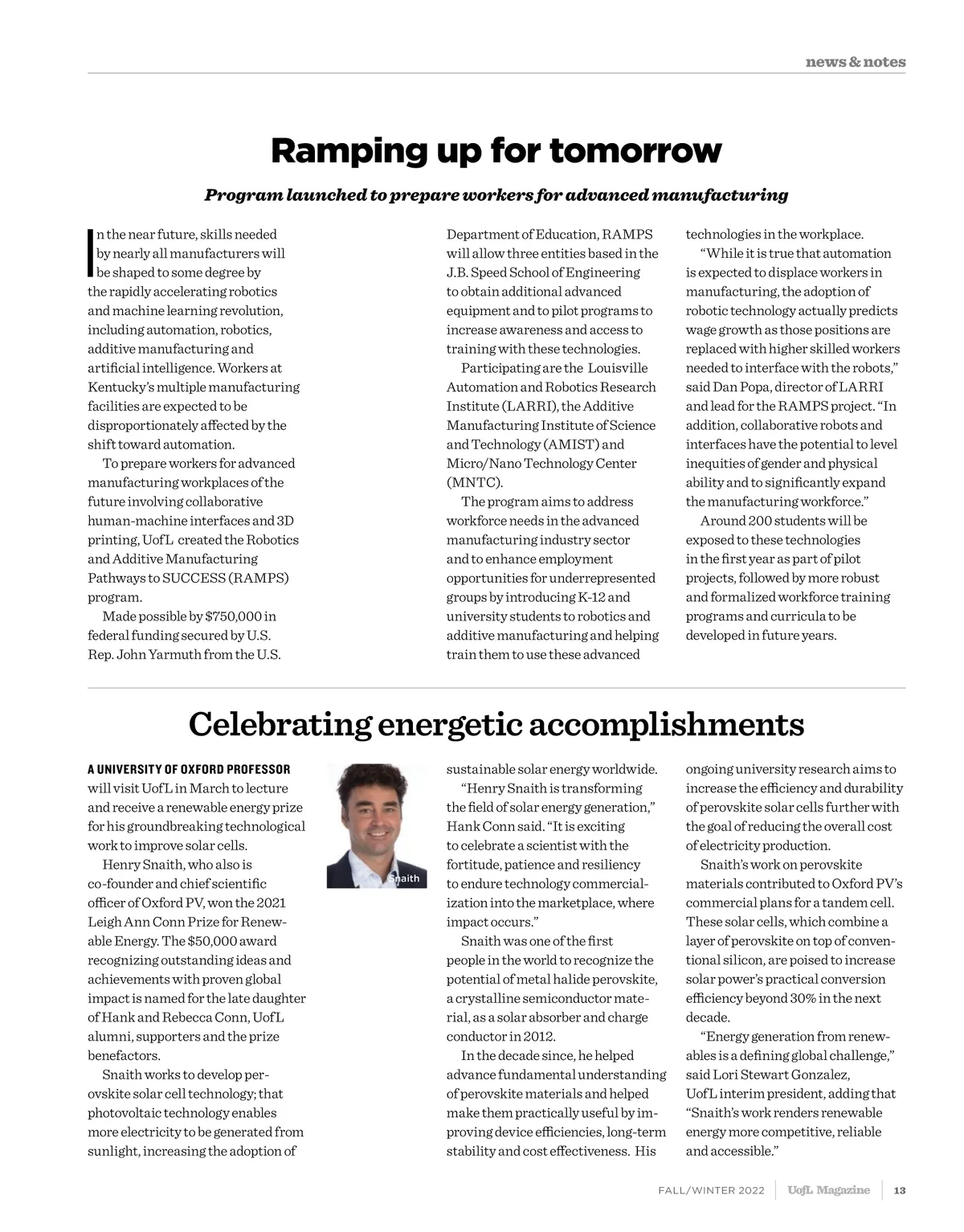
Ramping up for tomorrow Program launched to prepare workers for advanced manufacturing I n the near future, skills needed by nearly all manufacturers will be shaped to some degree by the rapidly accelerating robotics and machine learning revolution, including automation, robotics, additive manufacturing and artificial intelligence. Workers at Kentucky’s multiple manufacturing facilities are expected to be disproportionately affected by the shift toward automation. To prepare workers for advanced manufacturing workplaces of the future involving collaborative human-machine interfaces and 3D printing, UofL created the Robotics and Additive Manufacturing Pathways to SUCCESS (RAMPS) program. Made possible by $750,000 in federal funding secured by U.S. Rep. John Yarmuth from the U.S. Department of Education, RAMPS will allow three entities based in the J.B. Speed School of Engineering to obtain additional advanced equipment and to pilot programs to increase awareness and access to training with these technologies. Participating are the Louisville Automation and Robotics Research Institute (LARRI), the Additive Manufacturing Institute of Science and Technology (AMIST) and Micro/Nano Technology Center (MNTC). The program aims to address workforce needs in the advanced manufacturing industry sector and to enhance employment opportunities for underrepresented groups by introducing K-12 and university students to robotics and additive manufacturing and helping train them to use these advanced technologies in the workplace. “While it is true that automation is expected to displace workers in manufacturing, the adoption of robotic technology actually predicts wage growth as those positions are replaced with higher skilled workers needed to interface with the robots,” said Dan Popa, director of LARRI and lead for the RAMPS project. “In addition, collaborative robots and interfaces have the potential to level inequities of gender and physical ability and to significantly expand the manufacturing workforce.” Around 200 students will be exposed to these technologies in the first year as part of pilot projects, followed by more robust and formalized workforce training programs and curricula to be developed in future years. Celebrating energetic accomplishments A UNIVERSITY OF OXFORD PROFESSOR will visit UofL in March to lecture and receive a renewable energy prize for his groundbreaking technological work to improve solar cells. Henry Snaith, who also is co-founder and chief scientific officer of Oxford PV, won the 2021 Leigh Ann Conn Prize for Renew-able Energy. The $50,000 award recognizing outstanding ideas and achievements with proven global impact is named for the late daughter of Hank and Rebecca Conn, UofL alumni, supporters and the prize benefactors. Snaith works to develop per-ovskite solar cell technology; that photovoltaic technology enables more electricity to be generated from sunlight, increasing the adoption of Snaith sustainable solar energy worldwide. “Henry Snaith is transforming the field of solar energy generation,” Hank Conn said. “It is exciting to celebrate a scientist with the fortitude, patience and resiliency to endure technology commercial-ization into the marketplace, where impact occurs.” Snaith was one of the first people in the world to recognize the potential of metal halide perovskite, a crystalline semiconductor mate-rial, as a solar absorber and charge conductor in 2012. In the decade since, he helped advance fundamental understanding of perovskite materials and helped make them practically useful by im-proving device efficiencies, long-term stability and cost effectiveness. His ongoing university research aims to increase the efficiency and durability of perovskite solar cells further with the goal of reducing the overall cost of electricity production. Snaith’s work on perovskite materials contributed to Oxford PV’s commercial plans for a tandem cell. These solar cells, which combine a layer of perovskite on top of conven-tional silicon, are poised to increase solar power’s practical conversion efficiency beyond 30% in the next decade. “Energy generation from renew-ables is a defining global challenge,” said Lori Stewart Gonzalez, UofL interim president, adding that “Snaith’s work renders renewable energy more competitive, reliable and accessible.” 13 FALL/WINTER 2022
University of Louisville Fall/Winter 2022: Page 15