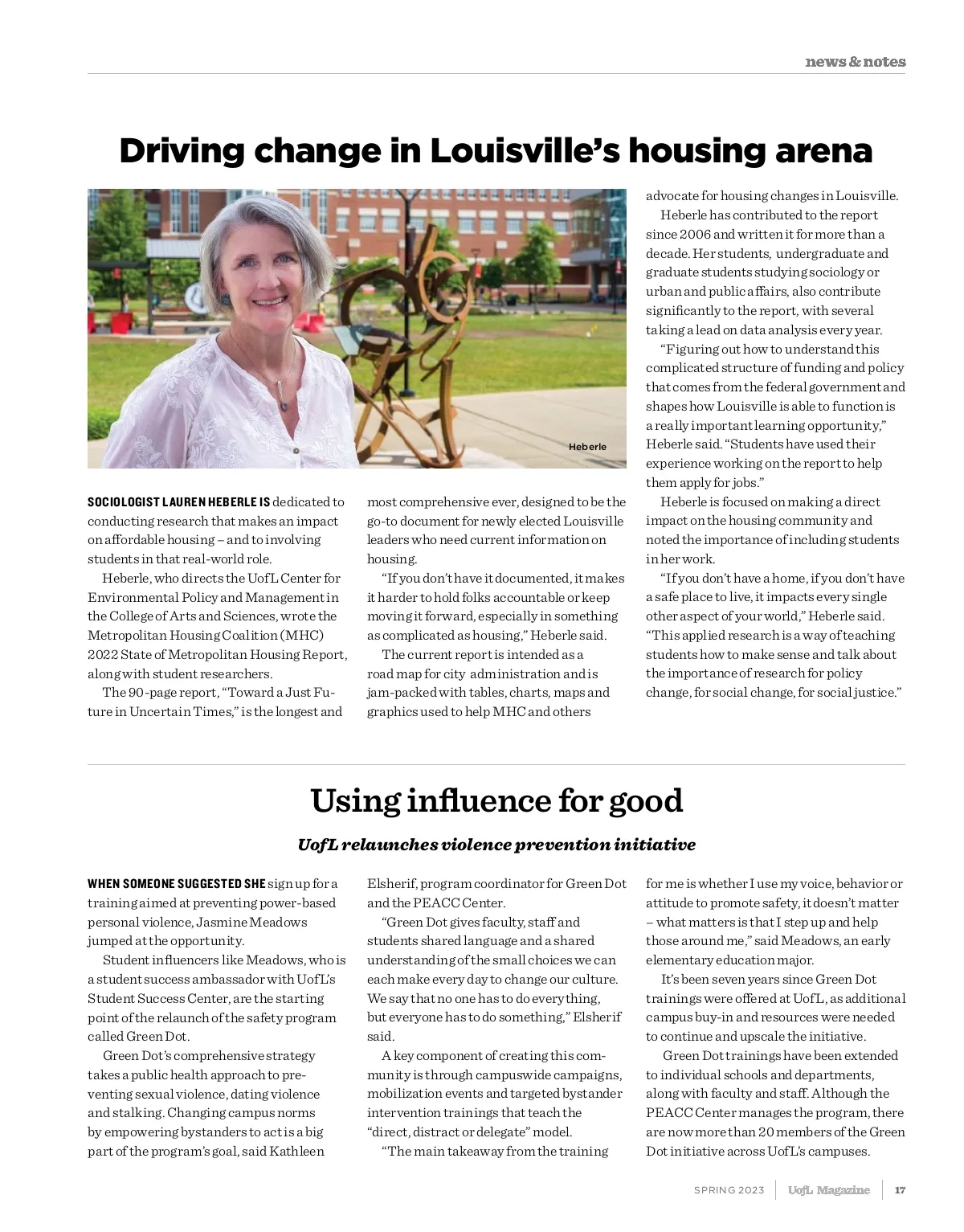
Driving change in Louisville’s housing arena advocate for housing changes in Louisville. Heberle has contributed to the report since 2006 and written it for more than a decade. Her students, undergraduate and graduate students studying sociology or urban and public affairs, also contribute significantly to the report, with several taking a lead on data analysis every year. “Figuring out how to understand this complicated structure of funding and policy that comes from the federal government and shapes how Louisville is able to function is a really important learning opportunity,” Heberle said. “Students have used their experience working on the report to help them apply for jobs.” Heberle is focused on making a direct impact on the housing community and noted the importance of including students in her work. “If you don’t have a home, if you don’t have a safe place to live, it impacts every single other aspect of your world,” Heberle said. “This applied research is a way of teaching students how to make sense and talk about the importance of research for policy change, for social change, for social justice.” Heberle SOCIOLOGIST LAUREN HEBERLE IS dedicated to conducting research that makes an impact on affordable housing – and to involving students in that real-world role. Heberle, who directs the UofL Center for Environmental Policy and Management in the College of Arts and Sciences, wrote the Metropolitan Housing Coalition (MHC) 2022 State of Metropolitan Housing Report, along with student researchers. The 90-page report, “Toward a Just Fu-ture in Uncertain Times,” is the longest and most comprehensive ever, designed to be the go-to document for newly elected Louisville leaders who need current information on housing. “If you don’t have it documented, it makes it harder to hold folks accountable or keep moving it forward, especially in something as complicated as housing,” Heberle said. The current report is intended as a road map for city administration and is jam-packed with tables, charts, maps and graphics used to help MHC and others Using influence for good UofL relaunches violence prevention initiative WHEN SOMEONE SUGGESTED SHE sign up for a training aimed at preventing power-based personal violence, Jasmine Meadows jumped at the opportunity. Student influencers like Meadows, who is a student success ambassador with UofL’s Student Success Center, are the starting point of the relaunch of the safety program called Green Dot. Green Dot’s comprehensive strategy takes a public health approach to pre-venting sexual violence, dating violence and stalking. Changing campus norms by empowering bystanders to act is a big part of the program’s goal, said Kathleen Elsherif, program coordinator for Green Dot and the PEACC Center. “Green Dot gives faculty, staff and students shared language and a shared understanding of the small choices we can each make every day to change our culture. We say that no one has to do everything, but everyone has to do something,” Elsherif said. A key component of creating this com-munity is through campuswide campaigns, mobilization events and targeted bystander intervention trainings that teach the “direct, distract or delegate” model. “The main takeaway from the training for me is whether I use my voice, behavior or attitude to promote safety, it doesn’t matter – what matters is that I step up and help those around me,” said Meadows, an early elementary education major. It’s been seven years since Green Dot trainings were offered at UofL, as additional campus buy-in and resources were needed to continue and upscale the initiative. Green Dot trainings have been extended to individual schools and departments, along with faculty and staff. Although the PEACC Center manages the program, there are now more than 20 members of the Green Dot initiative across UofL’s campuses. SPRING 2023 17
University of Louisville Spring 2023: Page 17