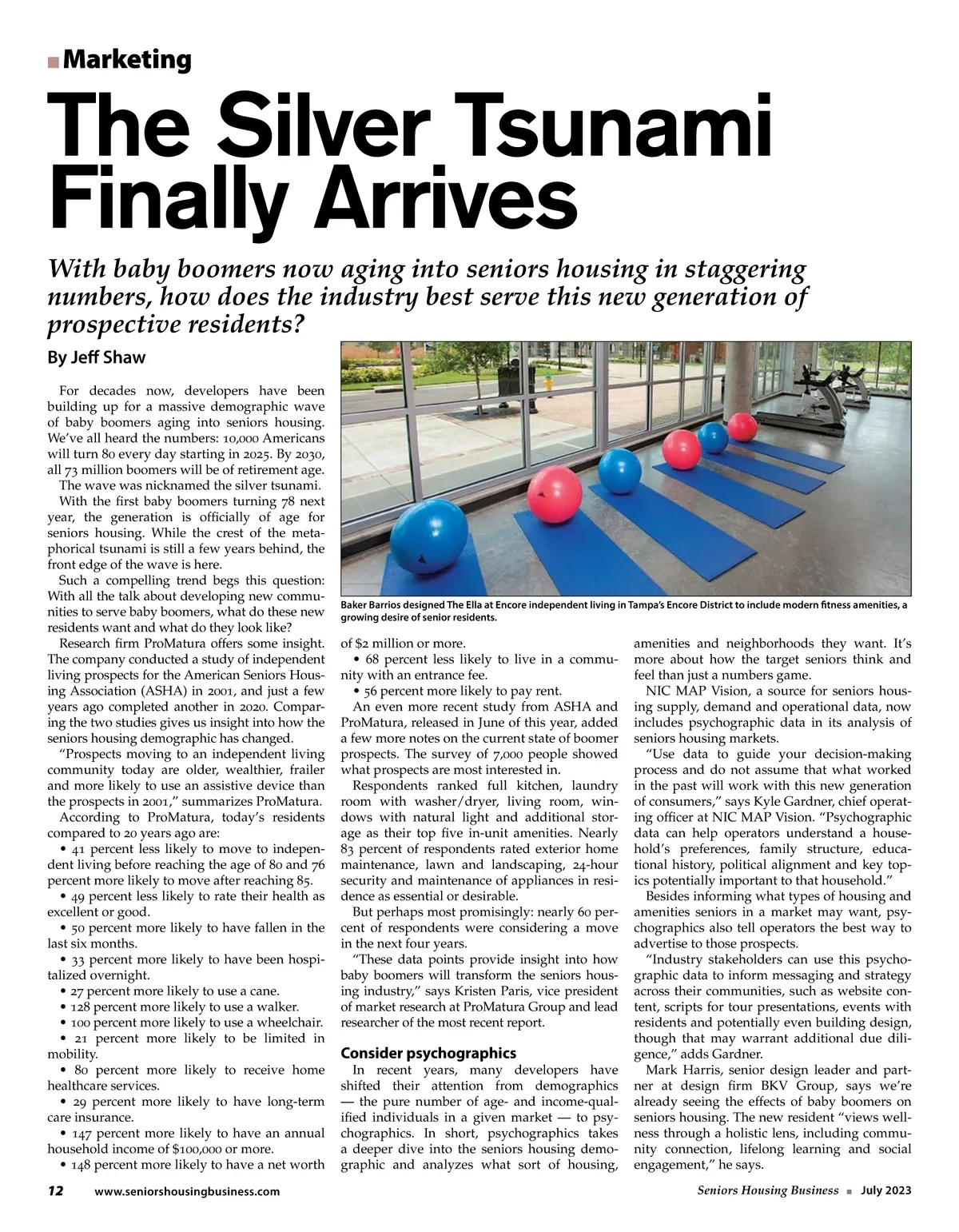
The Silver Tsunami Finally Arrives With baby boomers now aging into seniors housing in staggering numbers, how does the industry best serve this new generation of prospective residents? By Jeff Shaw For decades now, developers have been building up for a massive demographic wave of baby boomers aging into seniors housing. We’ve all heard the numbers: 10,000 Americans will turn 80 every day starting in 2025. By 2030, all 73 million boomers will be of retirement age. The wave was nicknamed the silver tsunami. With the first baby boomers turning 78 next year, the generation is officially of age for seniors housing. While the crest of the meta-phorical tsunami is still a few years behind, the front edge of the wave is here. Such a compelling trend begs this question: With all the talk about developing new commu-nities to serve baby boomers, what do these new residents want and what do they look like? Research firm ProMatura offers some insight. The company conducted a study of independent living prospects for the American Seniors Hous-ing Association (ASHA) in 2001, and just a few years ago completed another in 2020. Compar-ing the two studies gives us insight into how the seniors housing demographic has changed. “Prospects moving to an independent living community today are older, wealthier, frailer and more likely to use an assistive device than the prospects in 2001,” summarizes ProMatura. According to ProMatura, today’s residents compared to 20 years ago are: • 41 percent less likely to move to indepen-dent living before reaching the age of 80 and 76 percent more likely to move after reaching 85. • 49 percent less likely to rate their health as excellent or good. • 50 percent more likely to have fallen in the last six months. • 33 percent more likely to have been hospi-talized overnight. • 27 percent more likely to use a cane. • 128 percent more likely to use a walker. • 100 percent more likely to use a wheelchair. • 21 percent more likely to be limited in mobility. • 80 percent more likely to receive home healthcare services. • 29 percent more likely to have long-term care insurance. • 147 percent more likely to have an annual household income of $100,000 or more. • 148 percent more likely to have a net worth Marketing Baker Barrios designed The Ella at Encore independent living in Tampa’s Encore District to include modern fitness amenities, a growing desire of senior residents. of $2 million or more. • 68 percent less likely to live in a commu-nity with an entrance fee. • 56 percent more likely to pay rent. An even more recent study from ASHA and ProMatura, released in June of this year, added a few more notes on the current state of boomer prospects. The survey of 7,000 people showed what prospects are most interested in. Respondents ranked full kitchen, laundry room with washer/dryer, living room, win-dows with natural light and additional stor-age as their top five in-unit amenities. Nearly 83 percent of respondents rated exterior home maintenance, lawn and landscaping, 24-hour security and maintenance of appliances in resi-dence as essential or desirable. But perhaps most promisingly: nearly 60 per-cent of respondents were considering a move in the next four years. “These data points provide insight into how baby boomers will transform the seniors hous-ing industry,” says Kristen Paris, vice president of market research at ProMatura Group and lead researcher of the most recent report. Consider psychographics In recent years, many developers have shifted their attention from demographics — the pure number of age-and income-qual-ified individuals in a given market — to psy-chographics. In short, psychographics takes a deeper dive into the seniors housing demo-graphic and analyzes what sort of housing, amenities and neighborhoods they want. It’s more about how the target seniors think and feel than just a numbers game. NIC MAP Vision, a source for seniors hous-ing supply, demand and operational data, now includes psychographic data in its analysis of seniors housing markets. “Use data to guide your decision-making process and do not assume that what worked in the past will work with this new generation of consumers,” says Kyle Gardner, chief operat-ing officer at NIC MAP Vision. “Psychographic data can help operators understand a house-hold’s preferences, family structure, educa-tional history, political alignment and key top-ics potentially important to that household.” Besides informing what types of housing and amenities seniors in a market may want, psy-chographics also tell operators the best way to advertise to those prospects. “Industry stakeholders can use this psycho-graphic data to inform messaging and strategy across their communities, such as website con-tent, scripts for tour presentations, events with residents and potentially even building design, though that may warrant additional due dili-gence,” adds Gardner. Mark Harris, senior design leader and part-ner at design firm BKV Group, says we’re already seeing the effects of baby boomers on seniors housing. The new resident “views well-ness through a holistic lens, including commu-nity connection, lifelong learning and social engagement,” he says. Seniors Housing Business 12 www.seniorshousingbusiness.com July 2023
Seniors Housing Business July 2023: Page 12