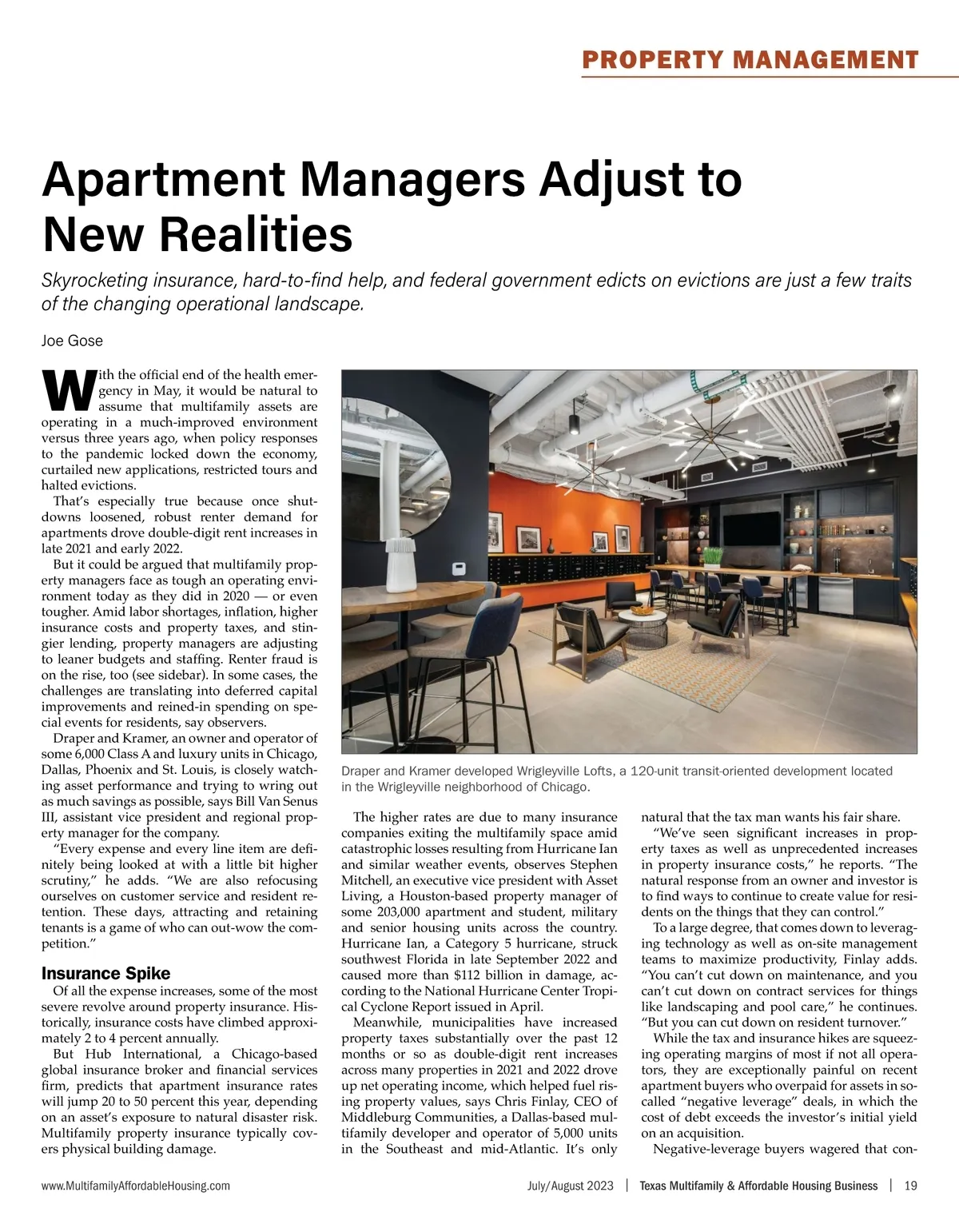
PROPERTY MANAGEMENT Apartment Managers Adjust to New Realities Skyrocketing insurance, hard-to-find help, and federal government edicts on evictions are just a few traits of the changing operational landscape. Joe Gose W ith the official end of the health emer -gency in May, it would be natural to assume that multifamily assets are operating in a much-improved environment versus three years ago, when policy responses to the pandemic locked down the economy, curtailed new applications, restricted tours and halted evictions. That’s especially true because once shut -downs loosened, robust renter demand for apartments drove double-digit rent increases in late 2021 and early 2022. But it could be argued that multifamily prop -erty managers face as tough an operating envi -ronment today as they did in 2020 — or even tougher. Amid labor shortages, inflation, higher insurance costs and property taxes, and stin -gier lending, property managers are adjusting to leaner budgets and staffing. Renter fraud is on the rise, too (see sidebar). In some cases, the challenges are translating into deferred capital improvements and reined-in spending on spe -cial events for residents, say observers. Draper and Kramer, an owner and operator of some 6,000 Class A and luxury units in Chicago, Dallas, Phoenix and St. Louis, is closely watch -ing asset performance and trying to wring out as much savings as possible, says Bill Van Senus III, assistant vice president and regional prop -erty manager for the company. “Every expense and every line item are defi -nitely being looked at with a little bit higher scrutiny,” he adds. “We are also refocusing ourselves on customer service and resident re -tention. These days, attracting and retaining tenants is a game of who can out-wow the com -petition.” Draper and Kramer developed Wrigleyville Lofts, a 120-unit transit-oriented development located in the Wrigleyville neighborhood of Chicago. The higher rates are due to many insurance companies exiting the multifamily space amid catastrophic losses resulting from Hurricane Ian and similar weather events, observes Stephen Mitchell, an executive vice president with Asset Living, a Houston-based property manager of some 203,000 apartment and student, military and senior housing units across the country. Hurricane Ian, a Category 5 hurricane, struck southwest Florida in late September 2022 and caused more than $112 billion in damage, ac -cording to the National Hurricane Center Tropi -cal Cyclone Report issued in April. Meanwhile, municipalities have increased property taxes substantially over the past 12 months or so as double-digit rent increases across many properties in 2021 and 2022 drove up net operating income, which helped fuel ris -ing property values, says Chris Finlay, CEO of Middleburg Communities, a Dallas-based mul -tifamily developer and operator of 5,000 units in the Southeast and mid-Atlantic. It’s only natural that the tax man wants his fair share. “We’ve seen significant increases in prop -erty taxes as well as unprecedented increases in property insurance costs,” he reports. “The natural response from an owner and investor is to find ways to continue to create value for resi -dents on the things that they can control.” To a large degree, that comes down to leverag -ing technology as well as on-site management teams to maximize productivity, Finlay adds. “You can’t cut down on maintenance, and you can’t cut down on contract services for things like landscaping and pool care,” he continues. “But you can cut down on resident turnover.” While the tax and insurance hikes are squeez -ing operating margins of most if not all opera -tors, they are exceptionally painful on recent apartment buyers who overpaid for assets in so-called “negative leverage” deals, in which the cost of debt exceeds the investor’s initial yield on an acquisition. Negative-leverage buyers wagered that con -Insurance Spike Of all the expense increases, some of the most severe revolve around property insurance. His -torically, insurance costs have climbed approxi -mately 2 to 4 percent annually. But Hub International, a Chicago-based global insurance broker and financial services firm, predicts that apartment insurance rates will jump 20 to 50 percent this year, depending on an asset’s exposure to natural disaster risk. Multifamily property insurance typically cov -ers physical building damage. www.MultifamilyAffordableHousing.com July/August 2023 | Texas Multifamily & Affordable Housing Business | 19
Texas Multifamily & Affordable Housing Business July/August 2023: Page 19