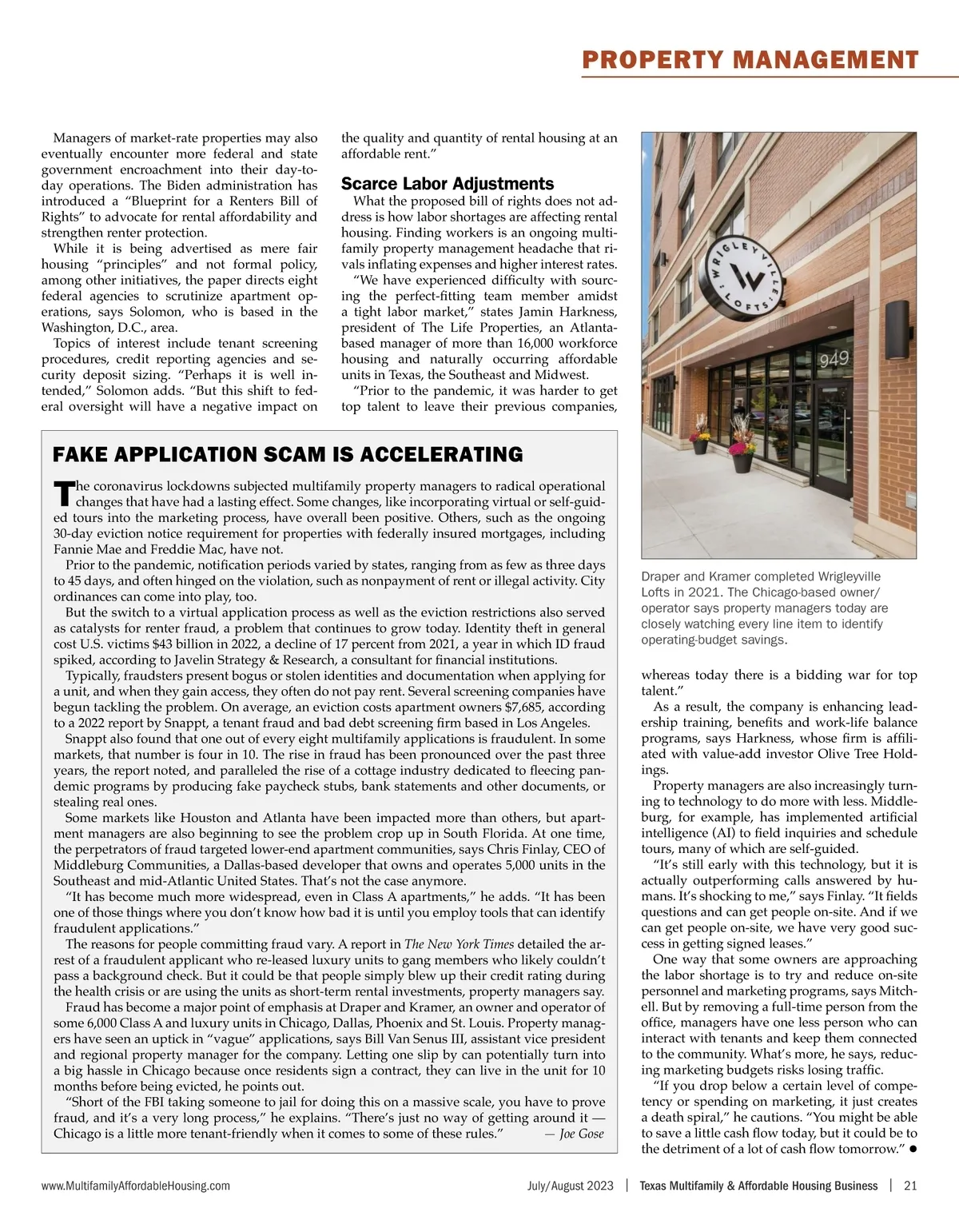
PROPERTY MANAGEMENT Managers of market-rate properties may also eventually encounter more federal and state government encroachment into their day-to-day operations. The Biden administration has introduced a “Blueprint for a Renters Bill of Rights” to advocate for rental affordability and strengthen renter protection. While it is being advertised as mere fair housing “principles” and not formal policy, among other initiatives, the paper directs eight federal agencies to scrutinize apartment op-erations, says Solomon, who is based in the Washington, D.C., area. Topics of interest include tenant screening procedures, credit reporting agencies and se-curity deposit sizing. “Perhaps it is well in-tended,” Solomon adds. “But this shift to fed-eral oversight will have a negative impact on the quality and quantity of rental housing at an affordable rent.” Scarce Labor Adjustments What the proposed bill of rights does not ad-dress is how labor shortages are affecting rental housing. Finding workers is an ongoing multi-family property management headache that ri-vals inflating expenses and higher interest rates. “We have experienced difficulty with sourc -ing the perfect-fitting team member amidst a tight labor market,” states Jamin Harkness, president of The Life Properties, an Atlanta-based manager of more than 16,000 workforce housing and naturally occurring affordable units in Texas, the Southeast and Midwest. “Prior to the pandemic, it was harder to get top talent to leave their previous companies, FAKE APPLICATION SCAM IS ACCELERATING he coronavirus lockdowns subjected multifamily property managers to radical operational changes that have had a lasting effect. Some changes, like incorporating virtual or self-guid-ed tours into the marketing process, have overall been positive. Others, such as the ongoing 30-day eviction notice requirement for properties with federally insured mortgages, including Fannie Mae and Freddie Mac, have not. Prior to the pandemic, notification periods varied by states, ranging from as few as three days to 45 days, and often hinged on the violation, such as nonpayment of rent or illegal activity. City ordinances can come into play, too. But the switch to a virtual application process as well as the eviction restrictions also served as catalysts for renter fraud, a problem that continues to grow today. Identity theft in general cost U.S. victims $43 billion in 2022, a decline of 17 percent from 2021, a year in which ID fraud spiked, according to Javelin Strategy & Research, a consultant for financial institutions. Typically, fraudsters present bogus or stolen identities and documentation when applying for a unit, and when they gain access, they often do not pay rent. Several screening companies have begun tackling the problem. On average, an eviction costs apartment owners $7,685, according to a 2022 report by Snappt, a tenant fraud and bad debt screening firm based in Los Angeles. Snappt also found that one out of every eight multifamily applications is fraudulent. In some markets, that number is four in 10. The rise in fraud has been pronounced over the past three years, the report noted, and paralleled the rise of a cottage industry dedicated to fleecing pan -demic programs by producing fake paycheck stubs, bank statements and other documents, or stealing real ones. Some markets like Houston and Atlanta have been impacted more than others, but apart-ment managers are also beginning to see the problem crop up in South Florida. At one time, the perpetrators of fraud targeted lower-end apartment communities, says Chris Finlay, CEO of Middleburg Communities, a Dallas-based developer that owns and operates 5,000 units in the Southeast and mid-Atlantic United States. That’s not the case anymore. “It has become much more widespread, even in Class A apartments,” he adds. “It has been one of those things where you don’t know how bad it is until you employ tools that can identify fraudulent applications.” The reasons for people committing fraud vary. A report in The New York Times detailed the ar-rest of a fraudulent applicant who re-leased luxury units to gang members who likely couldn’t pass a background check. But it could be that people simply blew up their credit rating during the health crisis or are using the units as short-term rental investments, property managers say. Fraud has become a major point of emphasis at Draper and Kramer, an owner and operator of some 6,000 Class A and luxury units in Chicago, Dallas, Phoenix and St. Louis. Property manag -ers have seen an uptick in “vague” applications, says Bill Van Senus III, assistant vice president and regional property manager for the company. Letting one slip by can potentially turn into a big hassle in Chicago because once residents sign a contract, they can live in the unit for 10 months before being evicted, he points out. “Short of the FBI taking someone to jail for doing this on a massive scale, you have to prove fraud, and it’s a very long process,” he explains. “There’s just no way of getting around it — Chicago is a little more tenant-friendly when it comes to some of these rules.” — Joe Gose T Draper and Kramer completed Wrigleyville Lofts in 2021. The Chicago-based owner/ operator says property managers today are closely watching every line item to identify operating-budget savings. whereas today there is a bidding war for top talent.” As a result, the company is enhancing lead-ership training, benefits and work-life balance programs, says Harkness, whose firm is affili -ated with value-add investor Olive Tree Hold-ings. Property managers are also increasingly turn-ing to technology to do more with less. Middle-burg, for example, has implemented artificial intelligence (AI) to field inquiries and schedule tours, many of which are self-guided. “It’s still early with this technology, but it is actually outperforming calls answered by hu-mans. It’s shocking to me,” says Finlay. “It fields questions and can get people on-site. And if we can get people on-site, we have very good suc-cess in getting signed leases.” One way that some owners are approaching the labor shortage is to try and reduce on-site personnel and marketing programs, says Mitch-ell. But by removing a full-time person from the office, managers have one less person who can interact with tenants and keep them connected to the community. What’s more, he says, reduc-ing marketing budgets risks losing traffic. “If you drop below a certain level of compe-tency or spending on marketing, it just creates a death spiral,” he cautions. “You might be able to save a little cash flow today, but it could be to the detriment of a lot of cash flow tomorrow.” www.MultifamilyAffordableHousing.com July/August 2023 | Texas Multifamily & Affordable Housing Business | 21
Texas Multifamily & Affordable Housing Business July/August 2023: Page 21