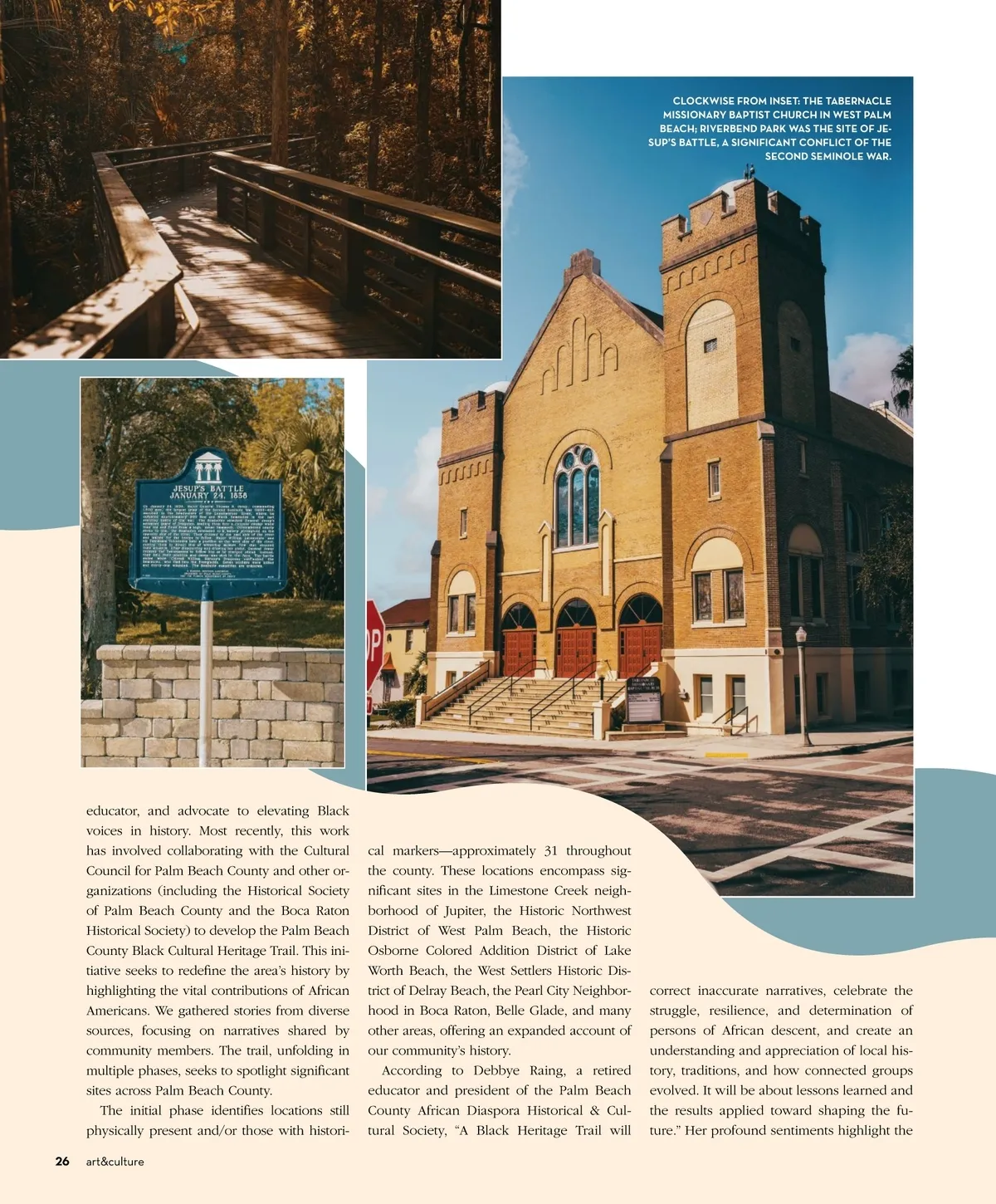
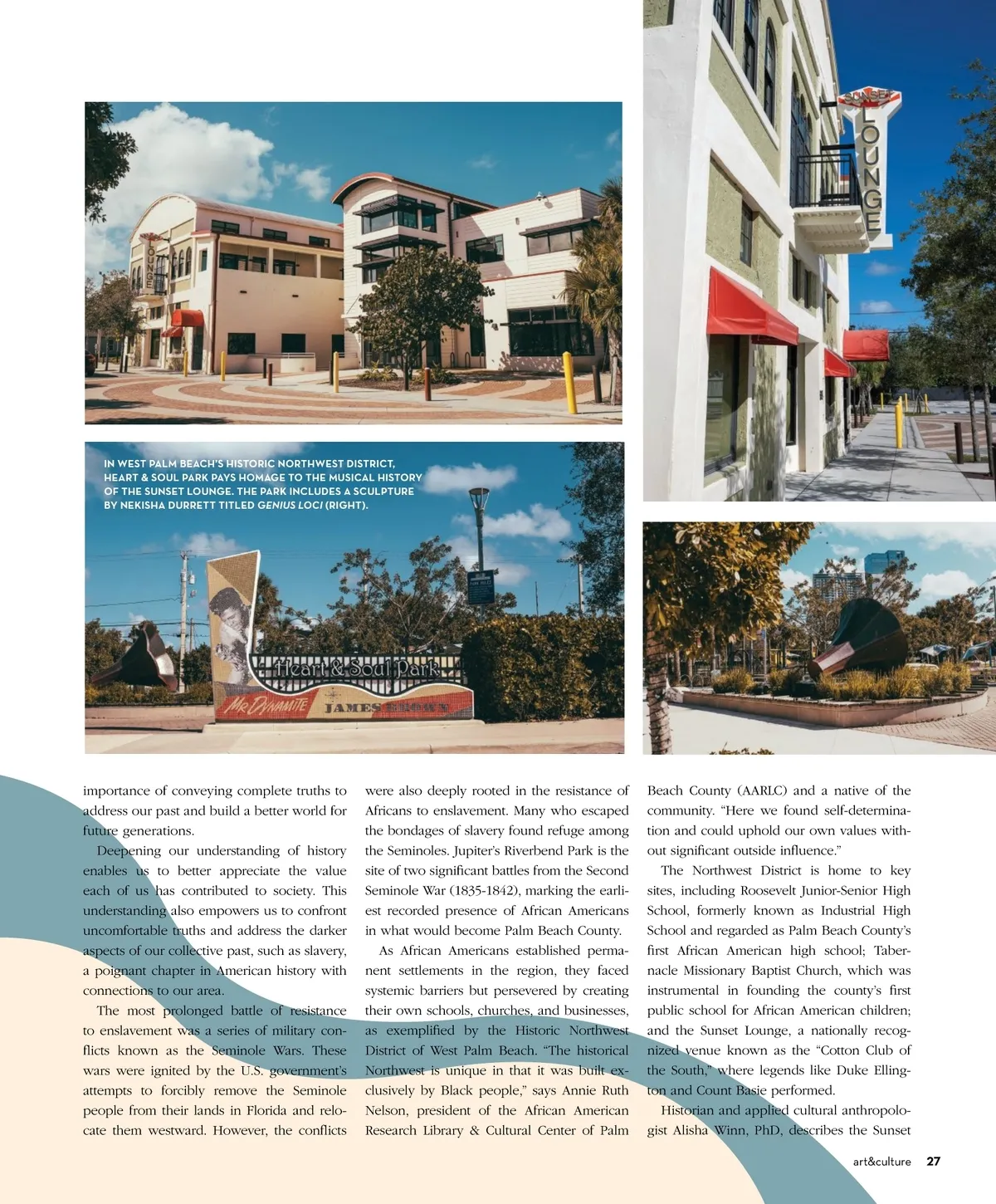
IN WEST PALM BEACH’S HISTORIC NORTHWEST DISTRICT, HEART & SOUL PARK PAYS HOMAGE TO THE MUSICAL HISTORY OF THE SUNSET LOUNGE. THE PARK INCLUDES A SCULPTURE BY NEKISHA DURRETT TITLED GENIUS LOCI (RIGHT). importance of conveying complete truths to address our past and build a better world for future generations. Deepening our understanding of history enables us to better appreciate the value each of us has contributed to society. This understanding also empowers us to confront uncomfortable truths and address the darker aspects of our collective past, such as slavery, a poignant chapter in American history with connections to our area. The most prolonged battle of resistance to enslavement was a series of military con-flicts known as the Seminole Wars. These wars were ignited by the U.S. government’s attempts to forcibly remove the Seminole people from their lands in Florida and relo-cate them westward. However, the conflicts were also deeply rooted in the resistance of Africans to enslavement. Many who escaped the bondages of slavery found refuge among the Seminoles. Jupiter’s Riverbend Park is the site of two significant battles from the Second Seminole War (1835-1842), marking the earli-est recorded presence of African Americans in what would become Palm Beach County. As African Americans established perma-nent settlements in the region, they faced systemic barriers but persevered by creating their own schools, churches, and businesses, as exemplified by the Historic Northwest District of West Palm Beach. “The historical Northwest is unique in that it was built ex-clusively by Black people,” says Annie Ruth Nelson, president of the African American Research Library & Cultural Center of Palm Beach County (AARLC) and a native of the community. “Here we found self-determina-tion and could uphold our own values with-out significant outside influence.” The Northwest District is home to key sites, including Roosevelt Junior-Senior High School, formerly known as Industrial High School and regarded as Palm Beach County’s first African American high school; Taber-nacle Missionary Baptist Church, which was instrumental in founding the county’s first public school for African American children; and the Sunset Lounge, a nationally recog-nized venue known as the “Cotton Club of the South,” where legends like Duke Elling-ton and Count Basie performed. Historian and applied cultural anthropolo-gist Alisha Winn, PhD, describes the Sunset art&culture 27
Art and Culture Winter 2025: Page 27