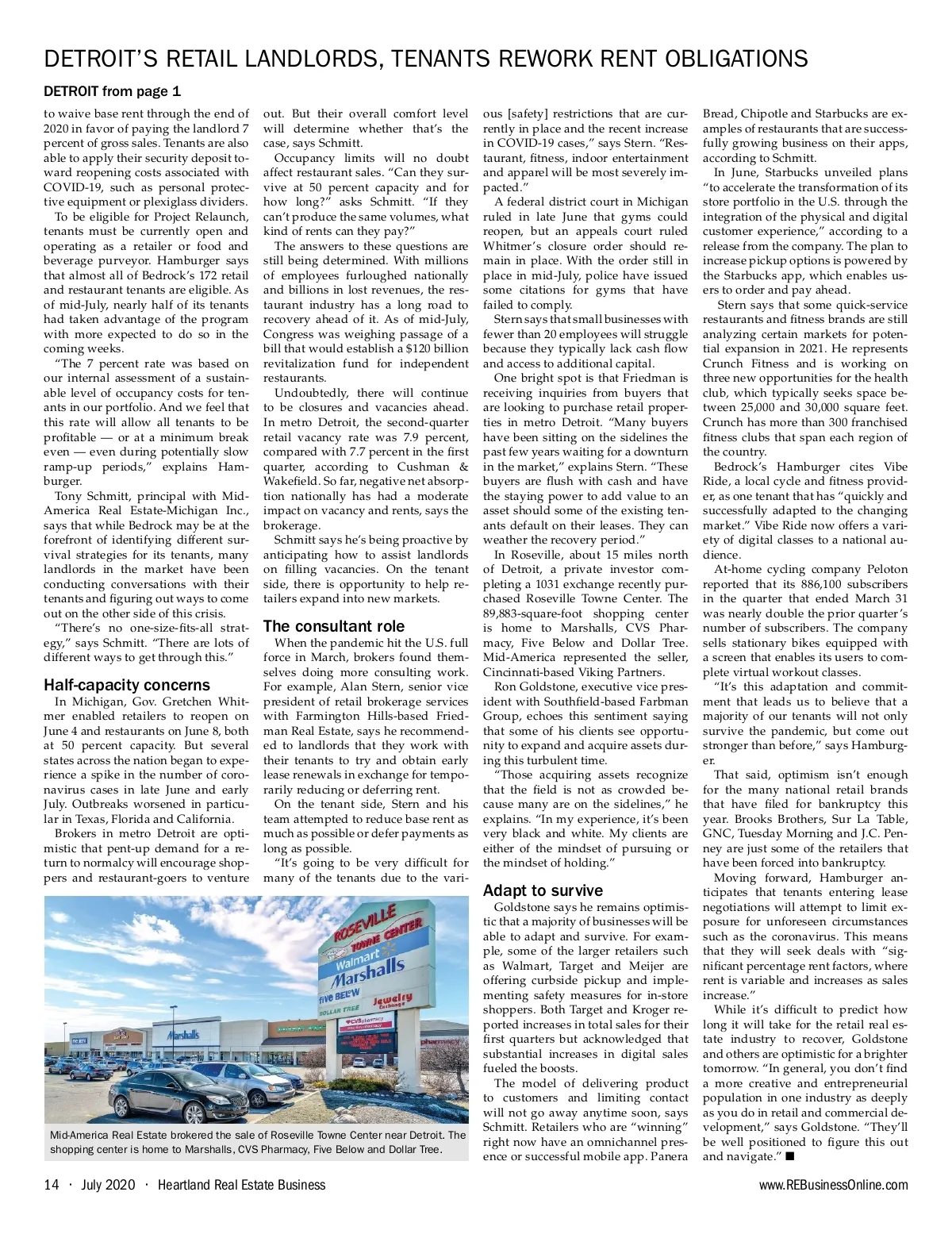
DETROIT’S RETAIL LANDLORDS, TENANTS REWORK RENT OBLIGATIONS DETROIT from page 1 to waive base rent through the end of 2020 in favor of paying the landlord 7 percent of gross sales. Tenants are also able to apply their security deposit to-ward reopening costs associated with COVID-19, such as personal protec-tive equipment or plexiglass dividers. To be eligible for Project Relaunch, tenants must be currently open and operating as a retailer or food and beverage purveyor. Hamburger says that almost all of Bedrock’s 172 retail and restaurant tenants are eligible. As of mid-July, nearly half of its tenants had taken advantage of the program with more expected to do so in the coming weeks. “The 7 percent rate was based on our internal assessment of a sustain-able level of occupancy costs for ten-ants in our portfolio. And we feel that this rate will allow all tenants to be profitable — or at a minimum break even — even during potentially slow ramp-up periods,” explains Ham-burger. Tony Schmitt, principal with Mid-America Real Estate-Michigan Inc., says that while Bedrock may be at the forefront of identifying different sur-vival strategies for its tenants, many landlords in the market have been conducting conversations with their tenants and figuring out ways to come out on the other side of this crisis. “There’s no one-size-fits-all strat-egy,” says Schmitt. “There are lots of different ways to get through this.” out. But their overall comfort level will determine whether that’s the case, says Schmitt. Occupancy limits will no doubt affect restaurant sales. “Can they sur-vive at 50 percent capacity and for how long?” asks Schmitt. “If they can’t produce the same volumes, what kind of rents can they pay?” The answers to these questions are still being determined. With millions of employees furloughed nationally and billions in lost revenues, the res-taurant industry has a long road to recovery ahead of it. As of mid-July, Congress was weighing passage of a bill that would establish a $120 billion revitalization fund for independent restaurants. Undoubtedly, there will continue to be closures and vacancies ahead. In metro Detroit, the second-quarter retail vacancy rate was 7.9 percent, compared with 7.7 percent in the first quarter, according to Cushman & Wakefield. So far, negative net absorp-tion nationally has had a moderate impact on vacancy and rents, says the brokerage. Schmitt says he’s being proactive by anticipating how to assist landlords on filling vacancies. On the tenant side, there is opportunity to help re-tailers expand into new markets. ous [safety] restrictions that are cur-rently in place and the recent increase in COVID-19 cases,” says Stern. “Res-taurant, fitness, indoor entertainment and apparel will be most severely im-pacted.” A federal district court in Michigan ruled in late June that gyms could reopen, but an appeals court ruled Whitmer’s closure order should re-main in place. With the order still in place in mid-July, police have issued some citations for gyms that have failed to comply. Stern says that small businesses with fewer than 20 employees will struggle because they typically lack cash flow and access to additional capital. One bright spot is that Friedman is receiving inquiries from buyers that are looking to purchase retail proper-ties in metro Detroit. “Many buyers have been sitting on the sidelines the past few years waiting for a downturn in the market,” explains Stern. “These buyers are flush with cash and have the staying power to add value to an asset should some of the existing ten-ants default on their leases. They can weather the recovery period.” In Roseville, about 15 miles north of Detroit, a private investor com-pleting a 1031 exchange recently pur-chased Roseville Towne Center. The 89,883-square-foot shopping center is home to Marshalls, CVS Phar-macy, Five Below and Dollar Tree. Mid-America represented the seller, Cincinnati-based Viking Partners. Ron Goldstone, executive vice pres-ident with Southfield-based Farbman Group, echoes this sentiment saying that some of his clients see opportu-nity to expand and acquire assets dur-ing this turbulent time. “Those acquiring assets recognize that the field is not as crowded be-cause many are on the sidelines,” he explains. “In my experience, it’s been very black and white. My clients are either of the mindset of pursuing or the mindset of holding.” Bread, Chipotle and Starbucks are ex-amples of restaurants that are success-fully growing business on their apps, according to Schmitt. In June, Starbucks unveiled plans “to accelerate the transformation of its store portfolio in the U.S. through the integration of the physical and digital customer experience,” according to a release from the company. The plan to increase pickup options is powered by the Starbucks app, which enables us-ers to order and pay ahead. Stern says that some quick-service restaurants and fitness brands are still analyzing certain markets for poten-tial expansion in 2021. He represents Crunch Fitness and is working on three new opportunities for the health club, which typically seeks space be-tween 25,000 and 30,000 square feet. Crunch has more than 300 franchised fitness clubs that span each region of the country. Bedrock’s Hamburger cites Vibe Ride, a local cycle and fitness provid-er, as one tenant that has “quickly and successfully adapted to the changing market.” Vibe Ride now offers a vari-ety of digital classes to a national au-dience. At-home cycling company Peloton reported that its 886,100 subscribers in the quarter that ended March 31 was nearly double the prior quarter’s number of subscribers. The company sells stationary bikes equipped with a screen that enables its users to com-plete virtual workout classes. “It’s this adaptation and commit-ment that leads us to believe that a majority of our tenants will not only survive the pandemic, but come out stronger than before,” says Hamburg-er. That said, optimism isn’t enough for the many national retail brands that have filed for bankruptcy this year. Brooks Brothers, Sur La Table, GNC, Tuesday Morning and J.C. Pen-ney are just some of the retailers that have been forced into bankruptcy. Moving forward, Hamburger an-ticipates that tenants entering lease negotiations will attempt to limit ex-posure for unforeseen circumstances such as the coronavirus. This means that they will seek deals with “sig-nificant percentage rent factors, where rent is variable and increases as sales increase.” While it’s difficult to predict how long it will take for the retail real es-tate industry to recover, Goldstone and others are optimistic for a brighter tomorrow. “In general, you don’t find a more creative and entrepreneurial population in one industry as deeply as you do in retail and commercial de-velopment,” says Goldstone. “They’ll be well positioned to figure this out and navigate.” n The consultant role Half-capacity concerns In Michigan, Gov. Gretchen Whit-mer enabled retailers to reopen on June 4 and restaurants on June 8, both at 50 percent capacity. But several states across the nation began to expe-rience a spike in the number of coro-navirus cases in late June and early July. Outbreaks worsened in particu-lar in Texas, Florida and California. Brokers in metro Detroit are opti-mistic that pent-up demand for a re-turn to normalcy will encourage shop-pers and restaurant-goers to venture When the pandemic hit the U.S. full force in March, brokers found them-selves doing more consulting work. For example, Alan Stern, senior vice president of retail brokerage services with Farmington Hills-based Fried-man Real Estate, says he recommend-ed to landlords that they work with their tenants to try and obtain early lease renewals in exchange for tempo-rarily reducing or deferring rent. On the tenant side, Stern and his team attempted to reduce base rent as much as possible or defer payments as long as possible. “It’s going to be very difficult for many of the tenants due to the vari-Adapt to survive Mid-America Real Estate brokered the sale of Roseville Towne Center near Detroit. The shopping center is home to Marshalls, CVS Pharmacy, Five Below and Dollar Tree. Goldstone says he remains optimis-tic that a majority of businesses will be able to adapt and survive. For exam-ple, some of the larger retailers such as Walmart, Target and Meijer are offering curbside pickup and imple-menting safety measures for in-store shoppers. Both Target and Kroger re-ported increases in total sales for their first quarters but acknowledged that substantial increases in digital sales fueled the boosts. The model of delivering product to customers and limiting contact will not go away anytime soon, says Schmitt. Retailers who are “winning” right now have an omnichannel pres-ence or successful mobile app. Panera 14 • July 2020 • Heartland Real Estate Business www.REBusinessOnline.com
Heartland Real Estate Business July 2020: Page 14