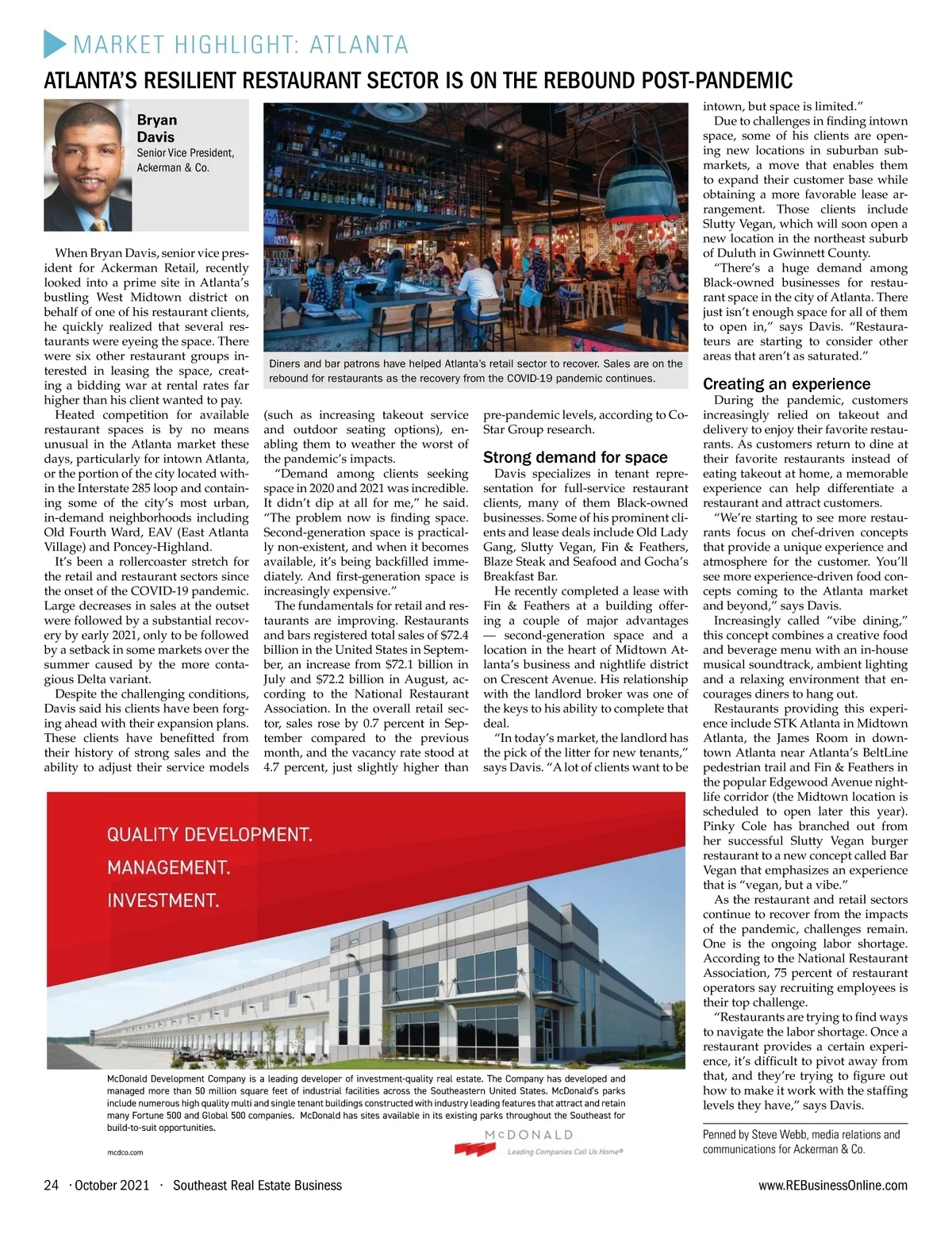
MARKET HIGHLIGHT: ATLANTA ATLANTA’S RESILIENT RESTAURANT SECTOR IS ON THE REBOUND POST-PANDEMIC Bryan Davis Senior Vice President, Ackerman & Co. intown, but space is limited.” Due to challenges in fi nding intown space, some of his clients are open-ing new locations in suburban sub-markets, a move that enables them to expand their customer base while obtaining a more favorable lease ar-rangement. Those clients include Slutty Vegan, which will soon open a new location in the northeast suburb of Duluth in Gwinnett County. “There’s a huge demand among Black-owned businesses for restau-rant space in the city of Atlanta. There just isn’t enough space for all of them to open in,” says Davis. “Restaura-teurs are starting to consider other areas that aren’t as saturated.” When Bryan Davis, senior vice pres-ident for Ackerman Retail, recently looked into a prime site in Atlanta’s bustling West Midtown district on behalf of one of his restaurant clients, he quickly realized that several res-taurants were eyeing the space. There were six other restaurant groups in-terested in leasing the space, creat-ing a bidding war at rental rates far higher than his client wanted to pay. Heated competition for available restaurant spaces is by no means unusual in the Atlanta market these days, particularly for intown Atlanta, or the portion of the city located with-in the Interstate 285 loop and contain-ing some of the city’s most urban, in-demand neighborhoods including Old Fourth Ward, EAV (East Atlanta Village) and Poncey-Highland. It’s been a rollercoaster stretch for the retail and restaurant sectors since the onset of the COVID-19 pandemic. Large decreases in sales at the outset were followed by a substantial recov-ery by early 2021, only to be followed by a setback in some markets over the summer caused by the more conta-gious Delta variant. Despite the challenging conditions, Davis said his clients have been forg-ing ahead with their expansion plans. These clients have benefi tted from their history of strong sales and the ability to adjust their service models Diners and bar patrons have helped Atlanta’s retail sector to recover. Sales are on the rebound for restaurants as the recovery from the COVID-19 pandemic continues. Creating an experience (such as increasing takeout service and outdoor seating options), en-abling them to weather the worst of the pandemic’s impacts. “Demand among clients seeking space in 2020 and 2021 was incredible. It didn’t dip at all for me,” he said. “The problem now is fi nding space. Second-generation space is practical-ly non-existent, and when it becomes available, it’s being backfi lled imme-diately. And fi rst-generation space is increasingly expensive.” The fundamentals for retail and res-taurants are improving. Restaurants and bars registered total sales of $72.4 billion in the United States in Septem-ber, an increase from $72.1 billion in July and $72.2 billion in August, ac-cording to the National Restaurant Association. In the overall retail sec-tor, sales rose by 0.7 percent in Sep-tember compared to the previous month, and the vacancy rate stood at 4.7 percent, just slightly higher than pre-pandemic levels, according to Co-Star Group research. Strong demand for space Davis specializes in tenant repre-sentation for full-service restaurant clients, many of them Black-owned businesses. Some of his prominent cli-ents and lease deals include Old Lady Gang, Slutty Vegan, Fin & Feathers, Blaze Steak and Seafood and Gocha’s Breakfast Bar. He recently completed a lease with Fin & Feathers at a building offer-ing a couple of major advantages — second-generation space and a location in the heart of Midtown At-lanta’s business and nightlife district on Crescent Avenue. His relationship with the landlord broker was one of the keys to his ability to complete that deal. “In today’s market, the landlord has the pick of the litter for new tenants,” says Davis. “A lot of clients want to be QUALITY DEVELOPMENT. MANAGEMENT. INVESTMENT. McDonald Development Company is a leading developer of investment-quality real estate. The Company has developed and managed more than 50 million square feet of industrial facilities across the Southeastern United States. McDonald’s parks include numerous high quality multi and single tenant buildings constructed with industry leading features that attract and retain many Fortune 500 and Global 500 companies. McDonald has sites available in its existing parks throughout the Southeast for build-to-suit opportunities. mcdco.com During the pandemic, customers increasingly relied on takeout and delivery to enjoy their favorite restau-rants. As customers return to dine at their favorite restaurants instead of eating takeout at home, a memorable experience can help differentiate a restaurant and attract customers. “We’re starting to see more restau-rants focus on chef-driven concepts that provide a unique experience and atmosphere for the customer. You’ll see more experience-driven food con-cepts coming to the Atlanta market and beyond,” says Davis. Increasingly called “vibe dining,” this concept combines a creative food and beverage menu with an in-house musical soundtrack, ambient lighting and a relaxing environment that en-courages diners to hang out. Restaurants providing this experi-ence include STK Atlanta in Midtown Atlanta, the James Room in down-town Atlanta near Atlanta’s BeltLine pedestrian trail and Fin & Feathers in the popular Edgewood Avenue night-life corridor (the Midtown location is scheduled to open later this year). Pinky Cole has branched out from her successful Slutty Vegan burger restaurant to a new concept called Bar Vegan that emphasizes an experience that is “vegan, but a vibe.” As the restaurant and retail sectors continue to recover from the impacts of the pandemic, challenges remain. One is the ongoing labor shortage. According to the National Restaurant Association, 75 percent of restaurant operators say recruiting employees is their top challenge. “Restaurants are trying to fi nd ways to navigate the labor shortage. Once a restaurant provides a certain experi-ence, it’s diffi cult to pivot away from that, and they’re trying to fi gure out how to make it work with the staffi ng levels they have,” says Davis. Penned by Steve Webb, media relations and communications for Ackerman & Co. 24 • October 2021 • Southeast Real Estate Business www.REBusinessOnline.com
Southeast Real Estate Business October 2021: Page 24