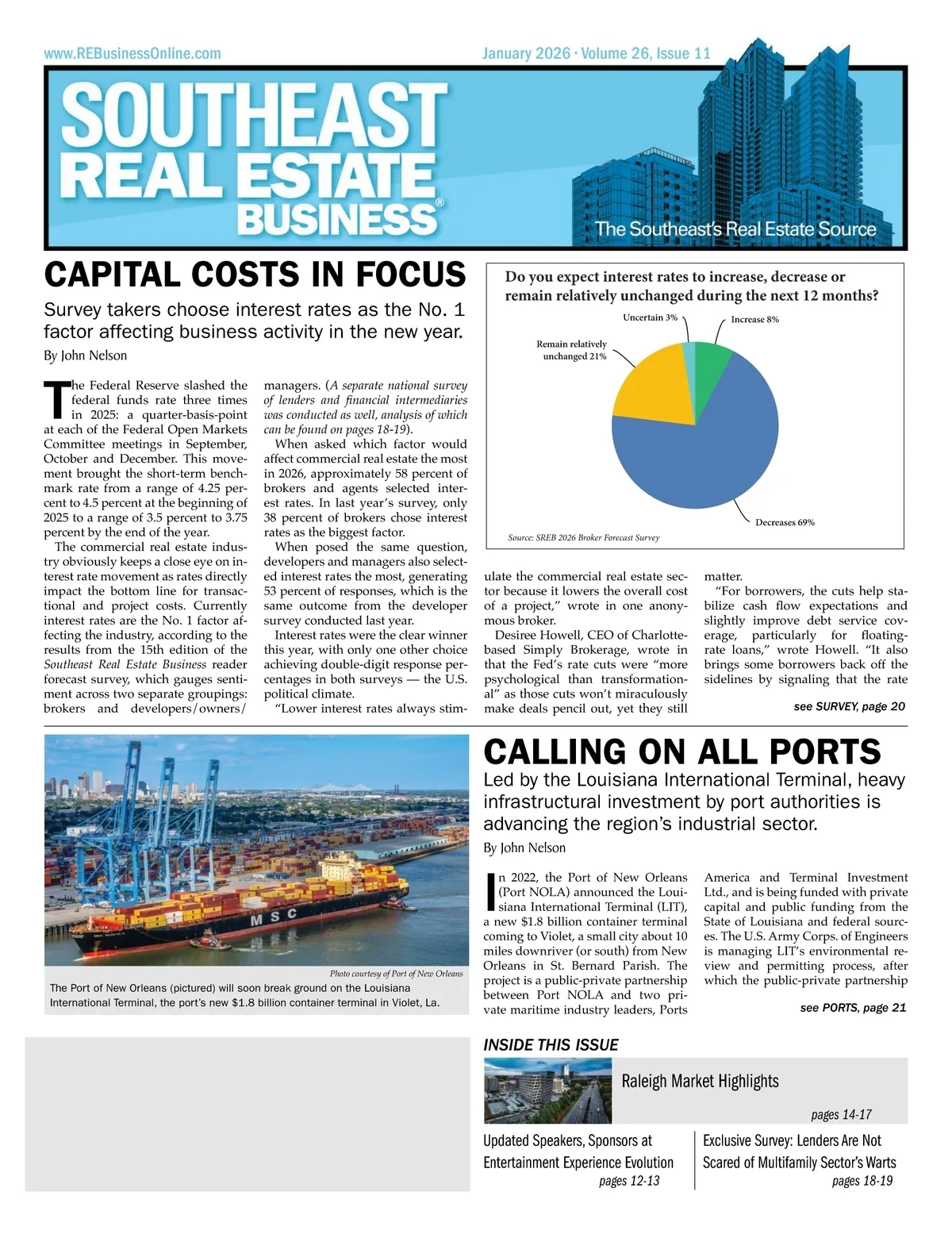
www.REBusinessOnline.com January 2026 • Volume 26, Issue 11 CAPITAL COSTS IN FOCUS Survey takers choose interest rates as the No. 1 factor affecting business activity in the new year. By John Nelson he Federal Reserve slashed the federal funds rate three times in 2025: a quarter-basis-point at each of the Federal Open Markets Committee meetings in September, October and December. This move-ment brought the short-term bench-mark rate from a range of 4.25 per-cent to 4.5 percent at the beginning of 2025 to a range of 3.5 percent to 3.75 percent by the end of the year. The commercial real estate indus-try obviously keeps a close eye on in-terest rate movement as rates directly impact the bottom line for transac-tional and project costs. Currently interest rates are the No. 1 factor af-fecting the industry, according to the results from the 15th edition of the Southeast Real Estate Business reader forecast survey, which gauges senti-ment across two separate groupings: brokers and developers/owners/ Do you expect interest rates to increase, decrease or remain relatively unchanged during the next 12 months? Uncertain 3% Remain relatively unchanged 21% Increase 8% T managers. ( A separate national survey of lenders and financial intermediaries was conducted as well, analysis of which can be found on pages 18-19 ). When asked which factor would affect commercial real estate the most in 2026, approximately 58 percent of brokers and agents selected inter-est rates. In last year’s survey, only 38 percent of brokers chose interest rates as the biggest factor. When posed the same question, developers and managers also select-ed interest rates the most, generating 53 percent of responses, which is the same outcome from the developer survey conducted last year. Interest rates were the clear winner this year, with only one other choice achieving double-digit response per-centages in both surveys — the U.S. political climate. “Lower interest rates always stim-Decreases 69% Source: SREB 2026 Broker Forecast Survey ulate the commercial real estate sec-tor because it lowers the overall cost of a project,” wrote in one anony-mous broker. Desiree Howell, CEO of Charlotte-based Simply Brokerage, wrote in that the Fed’s rate cuts were “more psychological than transformation-al” as those cuts won’t miraculously make deals pencil out, yet they still matter. “For borrowers, the cuts help sta-bilize cash flow expectations and slightly improve debt service cov-erage, particularly for floating-rate loans,” wrote Howell. “It also brings some borrowers back off the sidelines by signaling that the rate see SURVEY, page 20 CALLING ON ALL PORTS By John Nelson n 2022, the Port of New Orleans (Port NOLA) announced the Loui-siana International Terminal (LIT), a new $1.8 billion container terminal coming to Violet, a small city about 10 miles downriver (or south) from New Orleans in St. Bernard Parish. The project is a public-private partnership between Port NOLA and two pri-vate maritime industry leaders, Ports Led by the Louisiana International Terminal, heavy infrastructural investment by port authorities is advancing the region’s industrial sector. I Photo courtesy of Port of New Orleans The Port of New Orleans (pictured) will soon break ground on the Louisiana International Terminal, the port’s new $1.8 billion container terminal in Violet, La. America and Terminal Investment Ltd., and is being funded with private capital and public funding from the State of Louisiana and federal sourc-es. The U.S. Army Corps. of Engineers is managing LIT’s environmental re-view and permitting process, after which the public-private partnership see PORTS, page 21 INSIDE THIS ISSUE Raleigh Market Highlights pages 14-17 Updated Speakers, Sponsors at Entertainment Experience Evolution pages 12-13 Exclusive Survey: Lenders Are Not Scared of Multifamily Sector’s Warts pages 18-19
Southeast Real Estate Business January 2026: Page 1