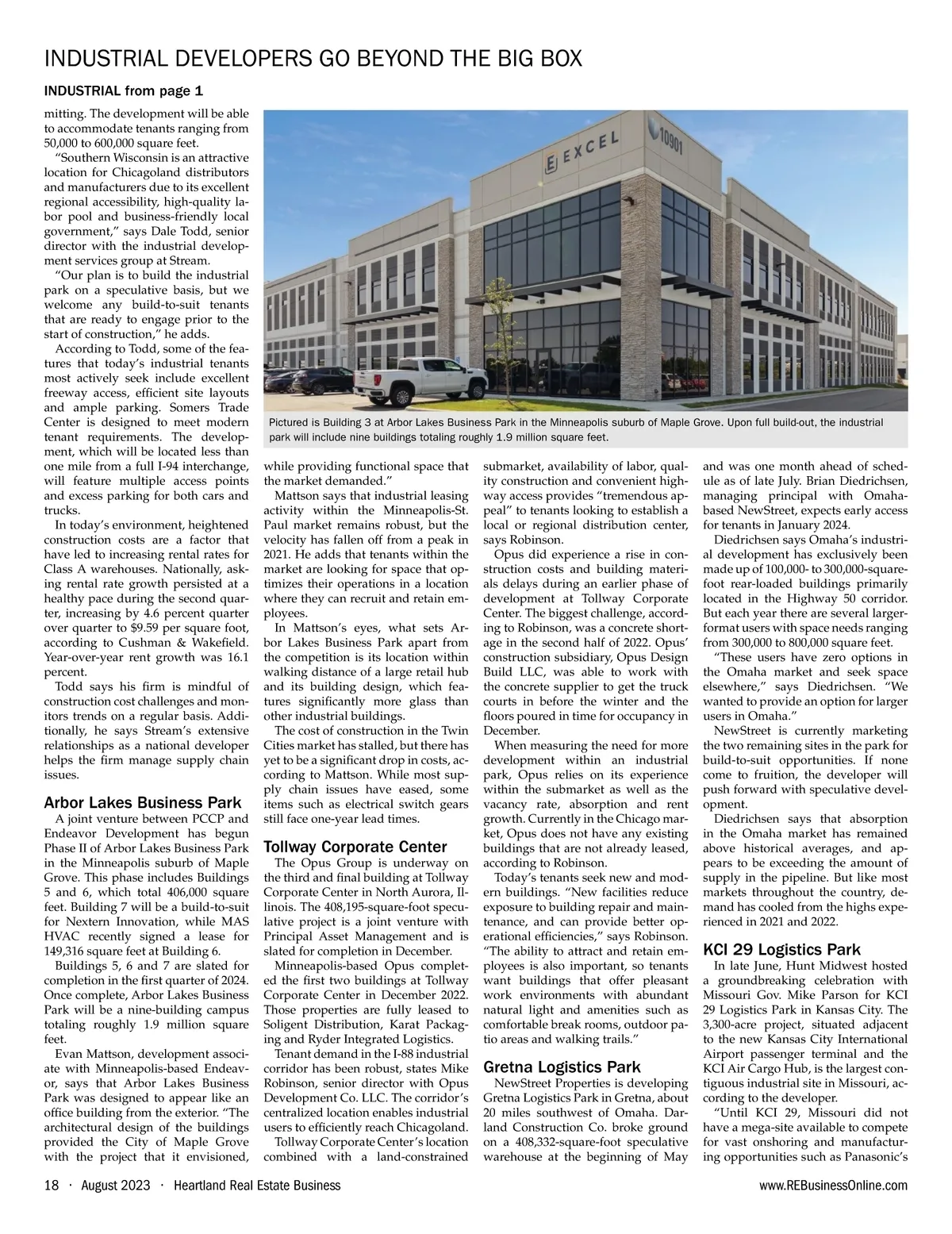
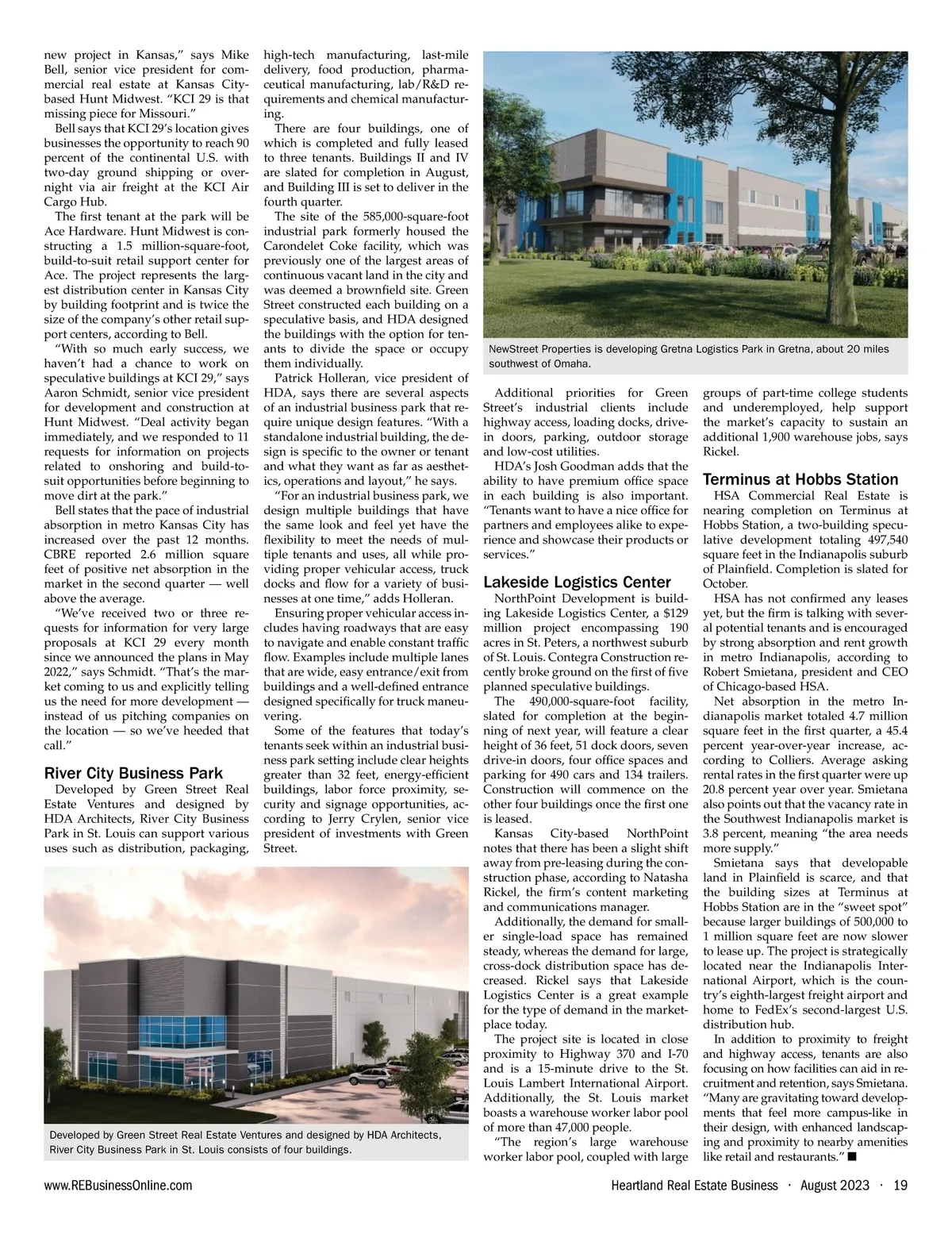
INDUSTRIAL DEVELOPERS GO BEYOND THE BIG BOX INDUSTRIAL from page 1 mitting. The development will be able to accommodate tenants ranging from 50,000 to 600,000 square feet. “Southern Wisconsin is an attractive location for Chicagoland distributors and manufacturers due to its excellent regional accessibility, high-quality la-bor pool and business-friendly local government,” says Dale Todd, senior director with the industrial develop-ment services group at Stream. “Our plan is to build the industrial park on a speculative basis, but we welcome any build-to-suit tenants that are ready to engage prior to the start of construction,” he adds. According to Todd, some of the fea-tures that today’s industrial tenants most actively seek include excellent freeway access, efficient site layouts and ample parking. Somers Trade Center is designed to meet modern tenant requirements. The develop-ment, which will be located less than one mile from a full I-94 interchange, will feature multiple access points and excess parking for both cars and trucks. In today’s environment, heightened construction costs are a factor that have led to increasing rental rates for Class A warehouses. Nationally, ask-ing rental rate growth persisted at a healthy pace during the second quar-ter, increasing by 4.6 percent quarter over quarter to $9.59 per square foot, according to Cushman & Wakefield. Year-over-year rent growth was 16.1 percent. Todd says his firm is mindful of construction cost challenges and mon-itors trends on a regular basis. Addi-tionally, he says Stream’s extensive relationships as a national developer helps the firm manage supply chain issues. Pictured is Building 3 at Arbor Lakes Business Park in the Minneapolis suburb of Maple Grove. Upon full build-out, the industrial park will include nine buildings totaling roughly 1.9 million square feet. Arbor Lakes Business Park A joint venture between PCCP and Endeavor Development has begun Phase II of Arbor Lakes Business Park in the Minneapolis suburb of Maple Grove. This phase includes Buildings 5 and 6, which total 406,000 square feet. Building 7 will be a build-to-suit for Nextern Innovation, while MAS HVAC recently signed a lease for 149,316 square feet at Building 6. Buildings 5, 6 and 7 are slated for completion in the first quarter of 2024. Once complete, Arbor Lakes Business Park will be a nine-building campus totaling roughly 1.9 million square feet. Evan Mattson, development associ-ate with Minneapolis-based Endeav-or, says that Arbor Lakes Business Park was designed to appear like an office building from the exterior. “The architectural design of the buildings provided the City of Maple Grove with the project that it envisioned, while providing functional space that the market demanded.” Mattson says that industrial leasing activity within the Minneapolis-St. Paul market remains robust, but the velocity has fallen off from a peak in 2021. He adds that tenants within the market are looking for space that op-timizes their operations in a location where they can recruit and retain em-ployees. In Mattson’s eyes, what sets Ar-bor Lakes Business Park apart from the competition is its location within walking distance of a large retail hub and its building design, which fea-tures significantly more glass than other industrial buildings. The cost of construction in the Twin Cities market has stalled, but there has yet to be a significant drop in costs, ac-cording to Mattson. While most sup-ply chain issues have eased, some items such as electrical switch gears still face one-year lead times. Tollway Corporate Center The Opus Group is underway on the third and final building at Tollway Corporate Center in North Aurora, Il-linois. The 408,195-square-foot specu-lative project is a joint venture with Principal Asset Management and is slated for completion in December. Minneapolis-based Opus complet-ed the first two buildings at Tollway Corporate Center in December 2022. Those properties are fully leased to Soligent Distribution, Karat Packag-ing and Ryder Integrated Logistics. Tenant demand in the I-88 industrial corridor has been robust, states Mike Robinson, senior director with Opus Development Co. LLC. The corridor’s centralized location enables industrial users to efficiently reach Chicagoland. Tollway Corporate Center’s location combined with a land-constrained submarket, availability of labor, qual-ity construction and convenient high-way access provides “tremendous ap-peal” to tenants looking to establish a local or regional distribution center, says Robinson. Opus did experience a rise in con-struction costs and building materi-als delays during an earlier phase of development at Tollway Corporate Center. The biggest challenge, accord-ing to Robinson, was a concrete short-age in the second half of 2022. Opus’ construction subsidiary, Opus Design Build LLC, was able to work with the concrete supplier to get the truck courts in before the winter and the floors poured in time for occupancy in December. When measuring the need for more development within an industrial park, Opus relies on its experience within the submarket as well as the vacancy rate, absorption and rent growth. Currently in the Chicago mar-ket, Opus does not have any existing buildings that are not already leased, according to Robinson. Today’s tenants seek new and mod-ern buildings. “New facilities reduce exposure to building repair and main-tenance, and can provide better op-erational efficiencies,” says Robinson. “The ability to attract and retain em-ployees is also important, so tenants want buildings that offer pleasant work environments with abundant natural light and amenities such as comfortable break rooms, outdoor pa-tio areas and walking trails.” and was one month ahead of sched-ule as of late July. Brian Diedrichsen, managing principal with Omaha-based NewStreet, expects early access for tenants in January 2024. Diedrichsen says Omaha’s industri-al development has exclusively been made up of 100,000-to 300,000-square-foot rear-loaded buildings primarily located in the Highway 50 corridor. But each year there are several larger-format users with space needs ranging from 300,000 to 800,000 square feet. “These users have zero options in the Omaha market and seek space elsewhere,” says Diedrichsen. “We wanted to provide an option for larger users in Omaha.” NewStreet is currently marketing the two remaining sites in the park for build-to-suit opportunities. If none come to fruition, the developer will push forward with speculative devel-opment. Diedrichsen says that absorption in the Omaha market has remained above historical averages, and ap-pears to be exceeding the amount of supply in the pipeline. But like most markets throughout the country, de-mand has cooled from the highs expe-rienced in 2021 and 2022. KCI 29 Logistics Park Gretna Logistics Park NewStreet Properties is developing Gretna Logistics Park in Gretna, about 20 miles southwest of Omaha. Dar-land Construction Co. broke ground on a 408,332-square-foot speculative warehouse at the beginning of May In late June, Hunt Midwest hosted a groundbreaking celebration with Missouri Gov. Mike Parson for KCI 29 Logistics Park in Kansas City. The 3,300-acre project, situated adjacent to the new Kansas City International Airport passenger terminal and the KCI Air Cargo Hub, is the largest con-tiguous industrial site in Missouri, ac-cording to the developer. “Until KCI 29, Missouri did not have a mega-site available to compete for vast onshoring and manufactur-ing opportunities such as Panasonic’s 18 • August 2023 • Heartland Real Estate Business www.REBusinessOnline.com
Heartland Real Estate Business August 2023: 18