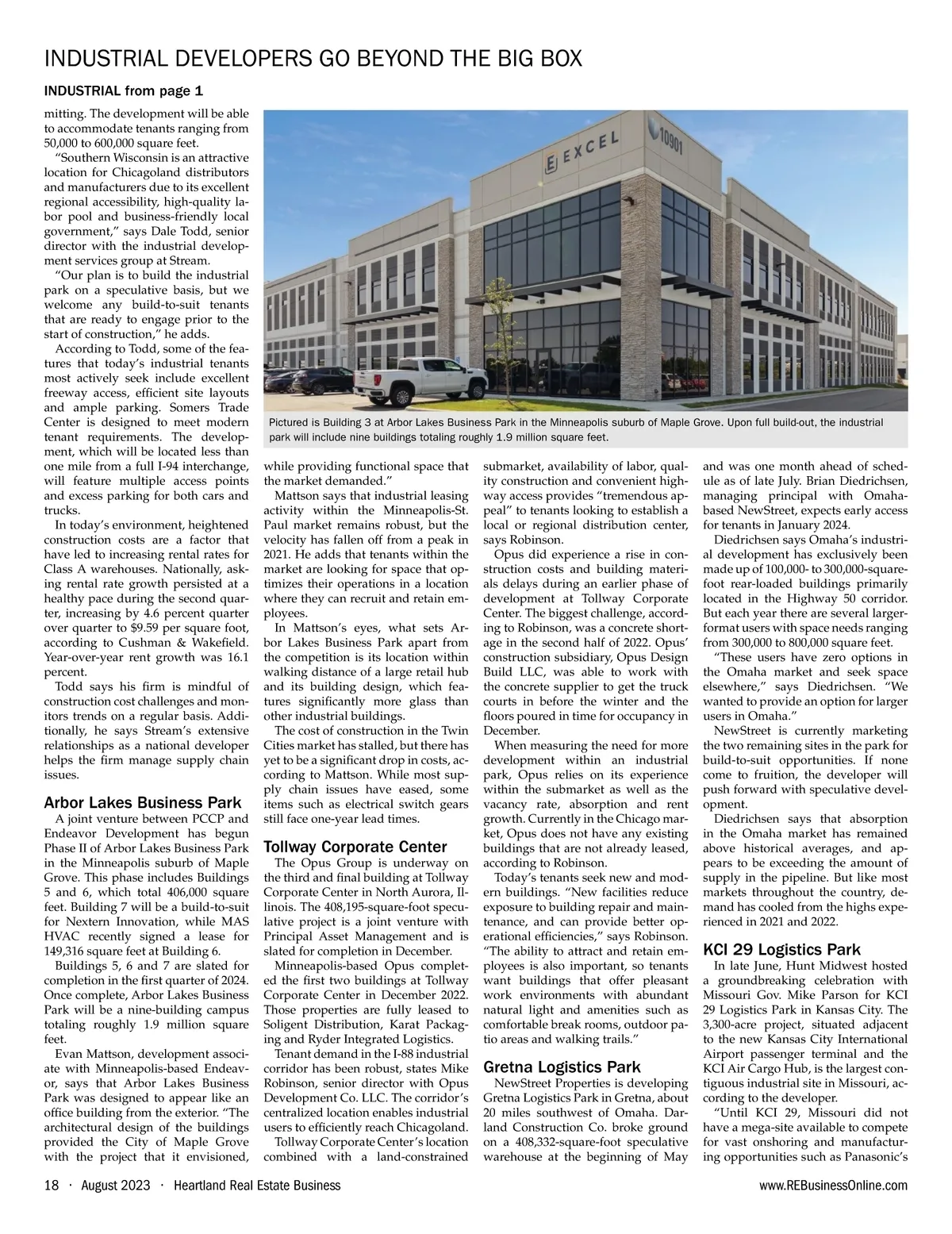
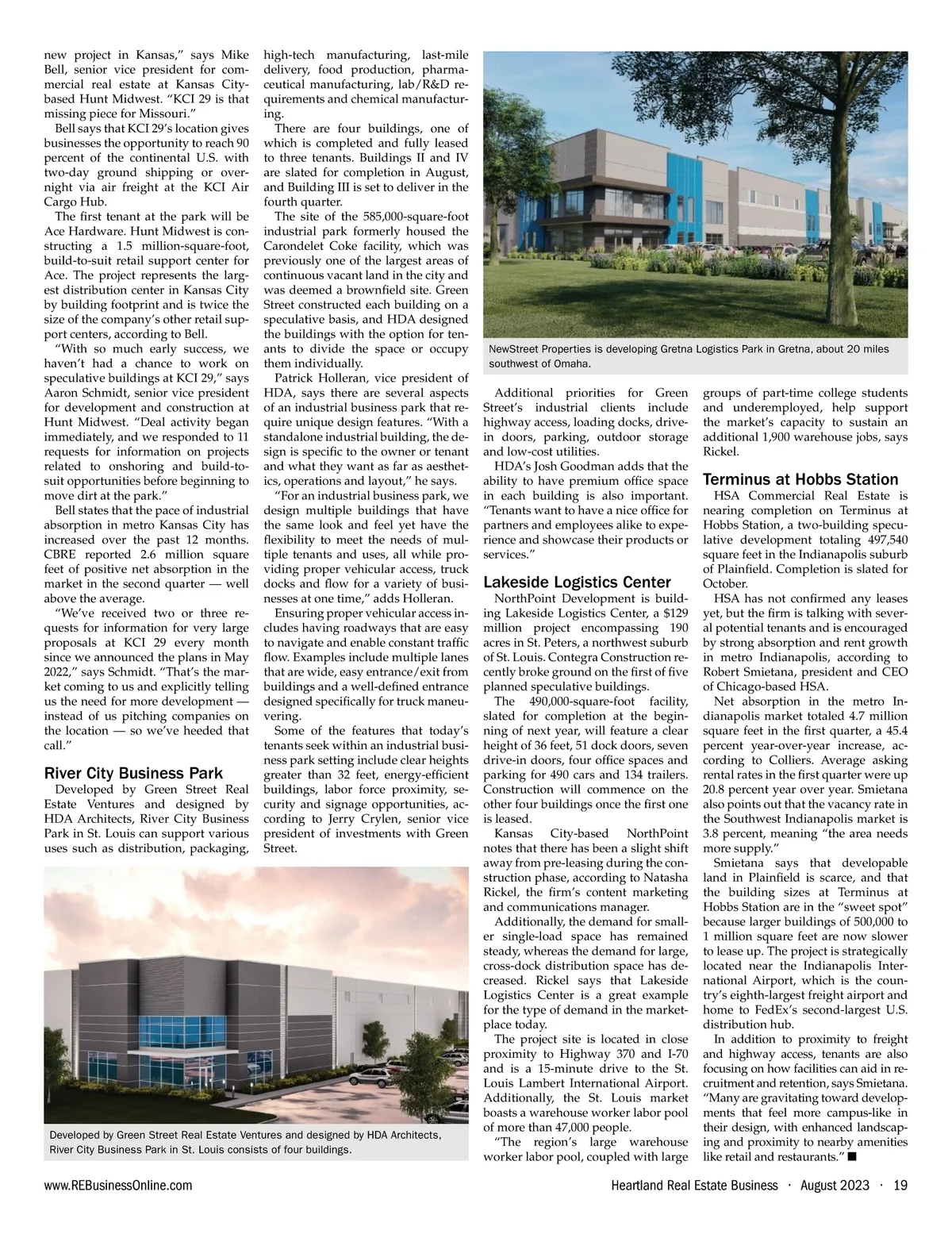
new project in Kansas,” says Mike Bell, senior vice president for com-mercial real estate at Kansas City-based Hunt Midwest. “KCI 29 is that missing piece for Missouri.” Bell says that KCI 29’s location gives businesses the opportunity to reach 90 percent of the continental U.S. with two-day ground shipping or over-night via air freight at the KCI Air Cargo Hub. The first tenant at the park will be Ace Hardware. Hunt Midwest is con-structing a 1.5 million-square-foot, build-to-suit retail support center for Ace. The project represents the larg-est distribution center in Kansas City by building footprint and is twice the size of the company’s other retail sup-port centers, according to Bell. “With so much early success, we haven’t had a chance to work on speculative buildings at KCI 29,” says Aaron Schmidt, senior vice president for development and construction at Hunt Midwest. “Deal activity began immediately, and we responded to 11 requests for information on projects related to onshoring and build-to-suit opportunities before beginning to move dirt at the park.” Bell states that the pace of industrial absorption in metro Kansas City has increased over the past 12 months. CBRE reported 2.6 million square feet of positive net absorption in the market in the second quarter — well above the average. “We’ve received two or three re-quests for information for very large proposals at KCI 29 every month since we announced the plans in May 2022,” says Schmidt. “That’s the mar-ket coming to us and explicitly telling us the need for more development — instead of us pitching companies on the location — so we’ve heeded that call.” River City Business Park Developed by Green Street Real Estate Ventures and designed by HDA Architects, River City Business Park in St. Louis can support various uses such as distribution, packaging, high-tech manufacturing, last-mile delivery, food production, pharma-ceutical manufacturing, lab/R&D re-quirements and chemical manufactur-ing. There are four buildings, one of which is completed and fully leased to three tenants. Buildings II and IV are slated for completion in August, and Building III is set to deliver in the fourth quarter. The site of the 585,000-square-foot industrial park formerly housed the Carondelet Coke facility, which was previously one of the largest areas of continuous vacant land in the city and was deemed a brownfield site. Green Street constructed each building on a speculative basis, and HDA designed the buildings with the option for ten-ants to divide the space or occupy them individually. Patrick Holleran, vice president of HDA, says there are several aspects of an industrial business park that re-quire unique design features. “With a standalone industrial building, the de-sign is specific to the owner or tenant and what they want as far as aesthet-ics, operations and layout,” he says. “For an industrial business park, we design multiple buildings that have the same look and feel yet have the flexibility to meet the needs of mul-tiple tenants and uses, all while pro-viding proper vehicular access, truck docks and flow for a variety of busi-nesses at one time,” adds Holleran. Ensuring proper vehicular access in-cludes having roadways that are easy to navigate and enable constant traffic flow. Examples include multiple lanes that are wide, easy entrance/exit from buildings and a well-defined entrance designed specifically for truck maneu-vering. Some of the features that today’s tenants seek within an industrial busi-ness park setting include clear heights greater than 32 feet, energy-efficient buildings, labor force proximity, se-curity and signage opportunities, ac-cording to Jerry Crylen, senior vice president of investments with Green Street. NewStreet Properties is developing Gretna Logistics Park in Gretna, about 20 miles southwest of Omaha. Additional priorities for Green Street’s industrial clients include highway access, loading docks, drive-in doors, parking, outdoor storage and low-cost utilities. HDA’s Josh Goodman adds that the ability to have premium office space in each building is also important. “Tenants want to have a nice office for partners and employees alike to expe-rience and showcase their products or services.” groups of part-time college students and underemployed, help support the market’s capacity to sustain an additional 1,900 warehouse jobs, says Rickel. Terminus at Hobbs Station Lakeside Logistics Center Developed by Green Street Real Estate Ventures and designed by HDA Architects, River City Business Park in St. Louis consists of four buildings. NorthPoint Development is build-ing Lakeside Logistics Center, a $129 million project encompassing 190 acres in St. Peters, a northwest suburb of St. Louis. Contegra Construction re-cently broke ground on the first of five planned speculative buildings. The 490,000-square-foot facility, slated for completion at the begin-ning of next year, will feature a clear height of 36 feet, 51 dock doors, seven drive-in doors, four office spaces and parking for 490 cars and 134 trailers. Construction will commence on the other four buildings once the first one is leased. Kansas City-based NorthPoint notes that there has been a slight shift away from pre-leasing during the con-struction phase, according to Natasha Rickel, the firm’s content marketing and communications manager. Additionally, the demand for small-er single-load space has remained steady, whereas the demand for large, cross-dock distribution space has de-creased. Rickel says that Lakeside Logistics Center is a great example for the type of demand in the market-place today. The project site is located in close proximity to Highway 370 and I-70 and is a 15-minute drive to the St. Louis Lambert International Airport. Additionally, the St. Louis market boasts a warehouse worker labor pool of more than 47,000 people. “The region’s large warehouse worker labor pool, coupled with large HSA Commercial Real Estate is nearing completion on Terminus at Hobbs Station, a two-building specu-lative development totaling 497,540 square feet in the Indianapolis suburb of Plainfield. Completion is slated for October. HSA has not confirmed any leases yet, but the firm is talking with sever-al potential tenants and is encouraged by strong absorption and rent growth in metro Indianapolis, according to Robert Smietana, president and CEO of Chicago-based HSA. Net absorption in the metro In-dianapolis market totaled 4.7 million square feet in the first quarter, a 45.4 percent year-over-year increase, ac-cording to Colliers. Average asking rental rates in the first quarter were up 20.8 percent year over year. Smietana also points out that the vacancy rate in the Southwest Indianapolis market is 3.8 percent, meaning “the area needs more supply.” Smietana says that developable land in Plainfield is scarce, and that the building sizes at Terminus at Hobbs Station are in the “sweet spot” because larger buildings of 500,000 to 1 million square feet are now slower to lease up. The project is strategically located near the Indianapolis Inter-national Airport, which is the coun-try’s eighth-largest freight airport and home to FedEx’s second-largest U.S. distribution hub. In addition to proximity to freight and highway access, tenants are also focusing on how facilities can aid in re-cruitment and retention, says Smietana. “Many are gravitating toward develop-ments that feel more campus-like in their design, with enhanced landscap-ing and proximity to nearby amenities like retail and restaurants.” www.REBusinessOnline.com Heartland Real Estate Business • August 2023 • 19
Heartland Real Estate Business August 2023: 19