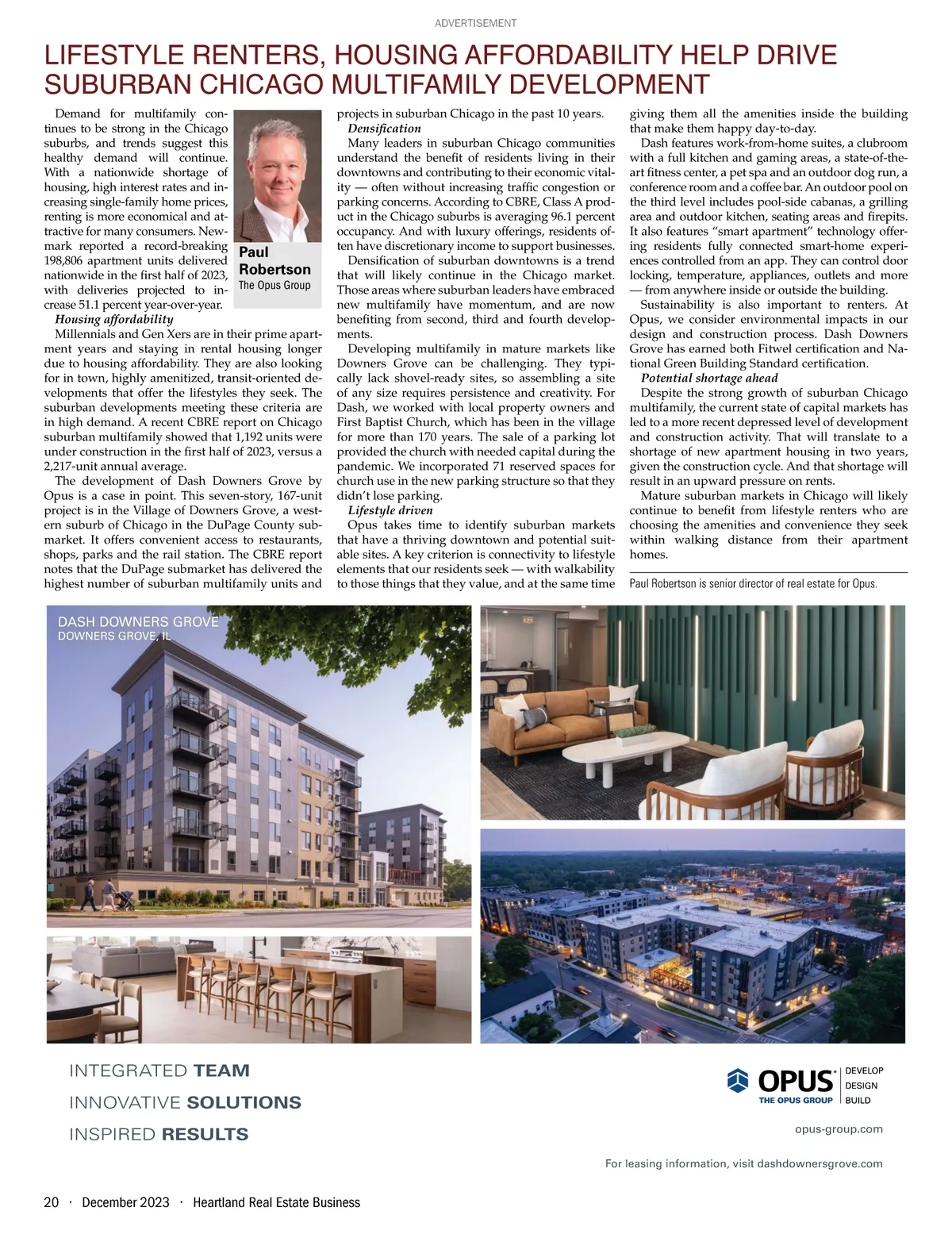
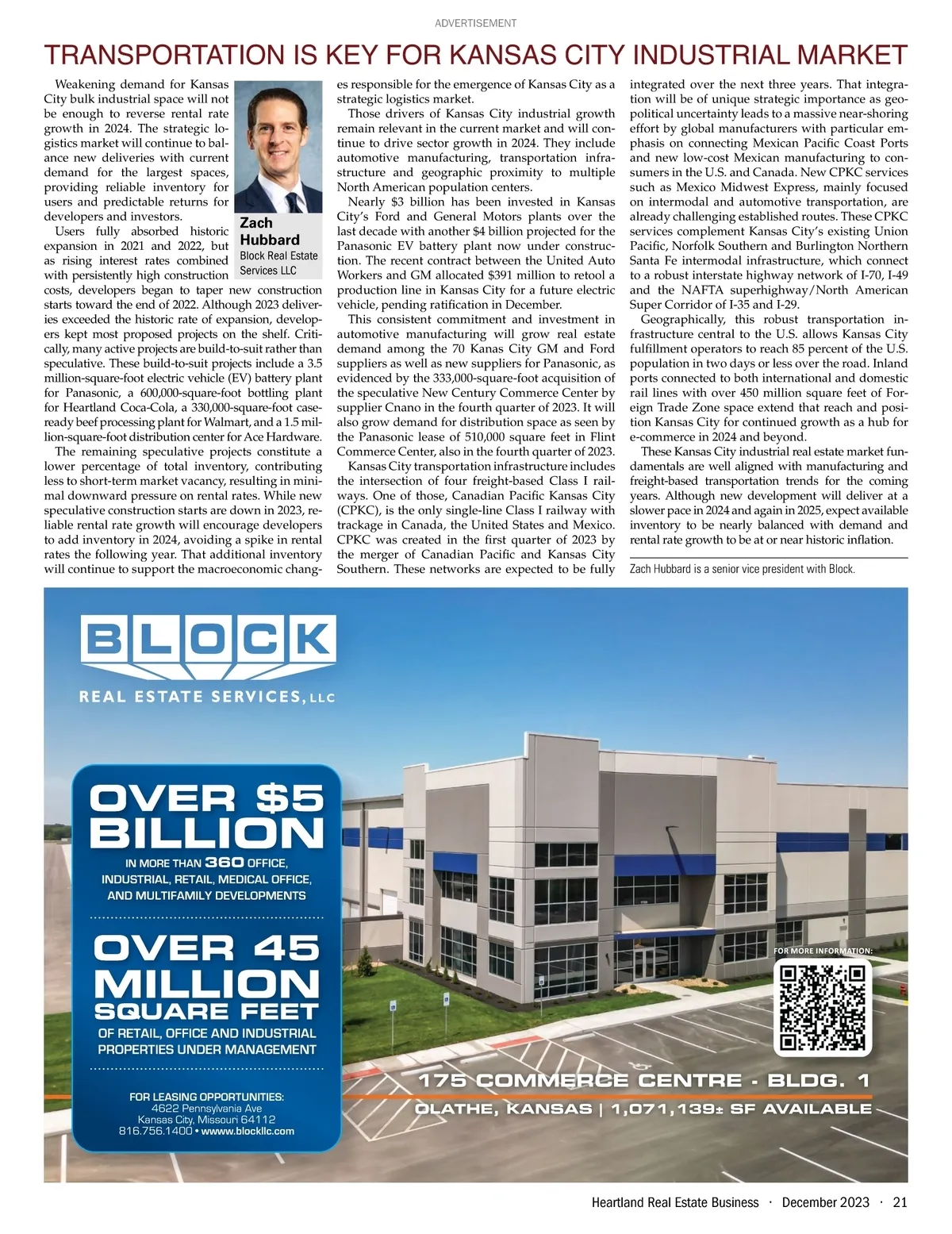
ADVERTISEMENT TRANSPORTATION IS KEY FOR KANSAS CITY INDUSTRIAL MARKET Weakening demand for Kansas City bulk industrial space will not be enough to reverse rental rate growth in 2024. The strategic lo-gistics market will continue to bal-ance new deliveries with current demand for the largest spaces, providing reliable inventory for users and predictable returns for developers and investors. Zach Users fully absorbed historic expansion in 2021 and 2022, but Hubbard as rising interest rates combined Block Real Estate with persistently high construction Services LLC costs, developers began to taper new construction starts toward the end of 2022. Although 2023 deliver-ies exceeded the historic rate of expansion, develop-ers kept most proposed projects on the shelf. Criti-cally, many active projects are build-to-suit rather than speculative. These build-to-suit projects include a 3.5 million-square-foot electric vehicle (EV) battery plant for Panasonic, a 600,000-square-foot bottling plant for Heartland Coca-Cola, a 330,000-square-foot case-ready beef processing plant for Walmart, and a 1.5 mil-lion-square-foot distribution center for Ace Hardware. The remaining speculative projects constitute a lower percentage of total inventory, contributing less to short-term market vacancy, resulting in mini-mal downward pressure on rental rates. While new speculative construction starts are down in 2023, re-liable rental rate growth will encourage developers to add inventory in 2024, avoiding a spike in rental rates the following year. That additional inventory will continue to support the macroeconomic chang-es responsible for the emergence of Kansas City as a strategic logistics market. Those drivers of Kansas City industrial growth remain relevant in the current market and will con-tinue to drive sector growth in 2024. They include automotive manufacturing, transportation infra-structure and geographic proximity to multiple North American population centers. Nearly $3 billion has been invested in Kansas City’s Ford and General Motors plants over the last decade with another $4 billion projected for the Panasonic EV battery plant now under construc-tion. The recent contract between the United Auto Workers and GM allocated $391 million to retool a production line in Kansas City for a future electric vehicle, pending rati cation in December. This consistent commitment and investment in automotive manufacturing will grow real estate demand among the 70 Kanas City GM and Ford suppliers as well as new suppliers for Panasonic, as evidenced by the 333,000-square-foot acquisition of the speculative New Century Commerce Center by supplier Cnano in the fourth quarter of 2023. It will also grow demand for distribution space as seen by the Panasonic lease of 510,000 square feet in Flint Commerce Center, also in the fourth quarter of 2023. Kansas City transportation infrastructure includes the intersection of four freight-based Class I rail-ways. One of those, Canadian Paci c Kansas City (CPKC), is the only single-line Class I railway with trackage in Canada, the United States and Mexico. CPKC was created in the rst quarter of 2023 by the merger of Canadian Paci c and Kansas City Southern. These networks are expected to be fully integrated over the next three years. That integra-tion will be of unique strategic importance as geo-political uncertainty leads to a massive near-shoring effort by global manufacturers with particular em-phasis on connecting Mexican Paci c Coast Ports and new low-cost Mexican manufacturing to con-sumers in the U.S. and Canada. New CPKC services such as Mexico Midwest Express, mainly focused on intermodal and automotive transportation, are already challenging established routes. These CPKC services complement Kansas City’s existing Union Paci c, Norfolk Southern and Burlington Northern Santa Fe intermodal infrastructure, which connect to a robust interstate highway network of I-70, I-49 and the NAFTA superhighway/North American Super Corridor of I-35 and I-29. Geographically, this robust transportation in-frastructure central to the U.S. allows Kansas City ful llment operators to reach 85 percent of the U.S. population in two days or less over the road. Inland ports connected to both international and domestic rail lines with over 450 million square feet of For-eign Trade Zone space extend that reach and posi-tion Kansas City for continued growth as a hub for e-commerce in 2024 and beyond. These Kansas City industrial real estate market fun-damentals are well aligned with manufacturing and freight-based transportation trends for the coming years. Although new development will deliver at a slower pace in 2024 and again in 2025, expect available inventory to be nearly balanced with demand and rental rate growth to be at or near historic in ation. Zach Hubbard is a senior vice president with Block. IN MORE THAN 360 OFFICE, INDUSTRIAL, RETAIL, MEDICAL OFFICE, AND MULTIFAMILY DEVELOPMENTS OVER 45 OF RETAIL, OFFICE AND INDUSTRIAL PROPERTIES UNDER MANAGEMENT FOR LEASING OPPORTUNITIES: 4622 Pennsylvania Ave Kansas City, Missouri 64112 816.756.1400 • wwww.blockllc.com 175 COMMERCE CENTRE -BLDG. 1 OLATHE, KANSAS | 1,071,139± SF AVAILABLE Heartland Real Estate Business • December 2023 • 21
Heartland Real Estate Business December 2023: Page 21